Pico-toning vs. Laser Toning: What's the Difference?
When you start looking into managing pigmentation, spots, or uneven skin tone with lasers, you keep running into two terms: "pico-toning" and "laser toning." They sometimes sound like the same thing, and other times they're introduced as completely different procedures, so many people end up unsure of exactly how they differ.
In this article, Dr. Kim Gun-woo of Cellinique, on Dosan-daero in Gangnam, walks you through the principles behind the two procedures, their main differences, and which skin concerns each approach may be considered for. If you're curious about pigmentation and spot care in general, take a look at the Guide to Melasma and Pigment Laser Care as well.
Summary in 3 lines
1. Laser toning uses a Q-switched Nd:YAG 1,064nm laser delivered at low fluence (1–3 J/cm²) in repeated sessions to gradually modulate melanocytes, while pico-toning uses ultra-short pulses in the picosecond domain (trillionths of a second) to enhance the photoacoustic effect and break pigment into finer particles.
2. In comparative clinical studies in Korea and abroad, the two approaches sometimes show similar efficacy for melasma improvement, while some studies show better results for the pico approach, so it cannot be concluded that "one is always better" — the suitable approach varies with skin condition, pigment type, and individual characteristics.
3. Both approaches carry side effects that require attention (temporary erythema, pigment recurrence, and rarely hypopigmentation), and suitability and the treatment plan should be decided individually during a prior consultation.
1. What Is Laser Toning? — Low-Energy Repeated Q-Switched Laser
Laser toning is an approach that delivers a Q-switched Nd:YAG laser, mainly at the 1,064nm wavelength, at very low energy (low fluence, typically 0.5–3.8 J/cm²) repeatedly over multiple sessions. It has been widely used since the early 2000s for managing melasma in Asian skin, and "Low-Fluence Q-Switched Nd:YAG laser toning (LFQSNY)" is the formal term for it.
Its mechanism is subcellular selective photothermolysis. It is described as selectively targeting melanosomes (pigment granules) and breaking them down with thermal energy, while altering the three-dimensional structure of melanocytes to help regulate pigment production. Unlike a single high-energy pass, the approach uses repeated low-energy stimulation to manage pigment while reducing overheating damage to surrounding tissue.
💡 Fact-check ✓
Sources: PMC9323185 (Lee YS et al., Medicina 2022, systematic review) · PMC10086227 (Frontiers in Medicine 2023)
- Low-fluence Q-switched Nd:YAG laser (laser toning) is described in a systematic review (PMC9323185, analyzing 42 studies) as an "overall effective and safe treatment" for melasma.
- Recommended protocol (per the literature): fluence 0.5–3.8 J/cm², spot size 6–10mm, frequency 5–10Hz, typically 9–10 sessions (1–2 week intervals). However, heterogeneity across studies is large, so it does not consolidate into a single optimal protocol.
- Side effects: mottled hypopigmentation (MH) reported in about 10% of East Asian patients. Long-term (3+ month) data is limited, and recurrence rates differ from study to study.
- Efficacy and duration vary by individual.
2. What Is Pico-toning? — Photoacoustic Effect in the Picosecond Domain
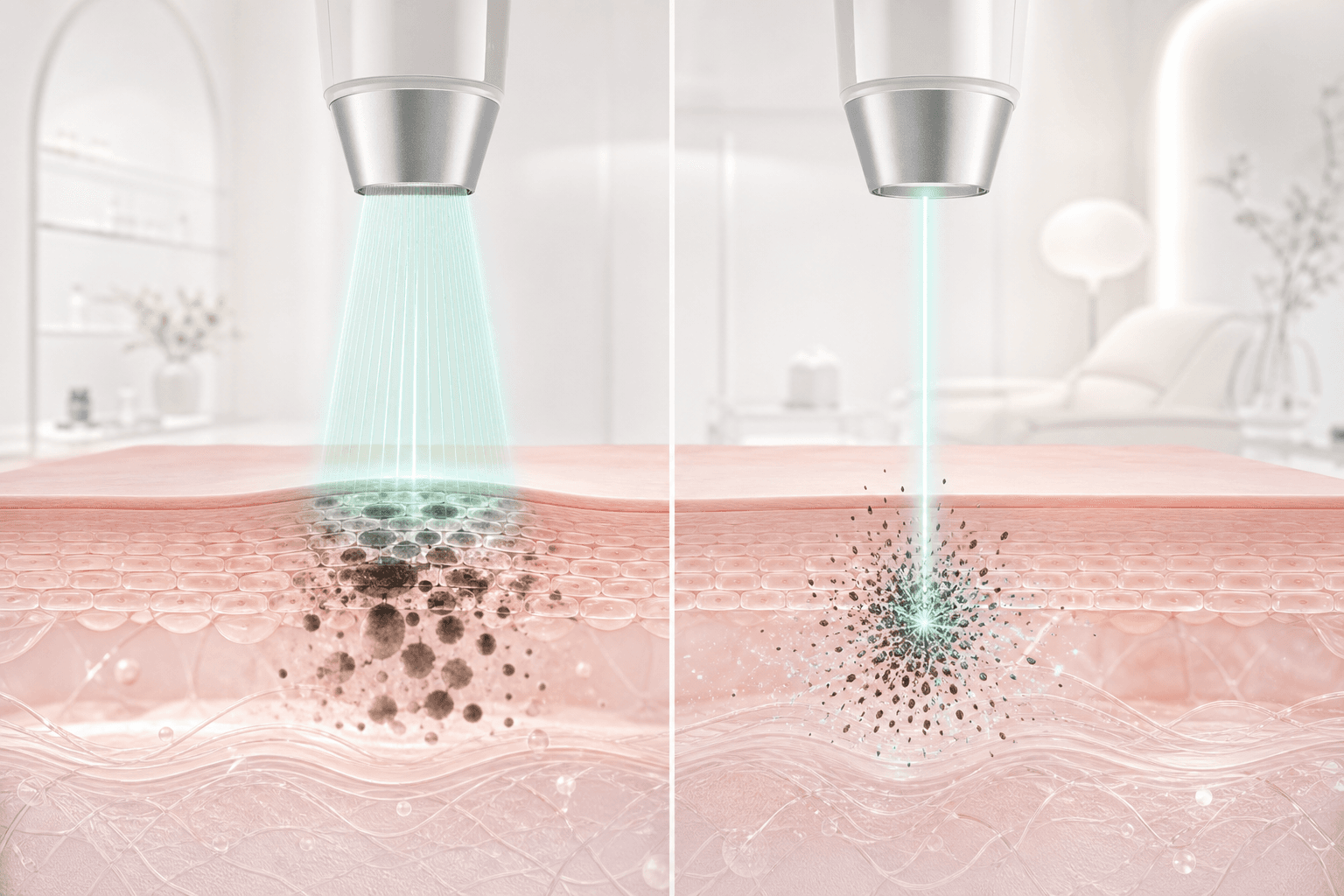
Pico-toning is an approach that delivers ultra-short pulse lasers in the picosecond (ps) domain at low fluence. Even when the same 1,064nm wavelength is used, shortening the pulse duration from nanoseconds (ns) to picoseconds changes how the energy is delivered.
While nanosecond lasers (Q-switched) rely mainly on the photothermal effect, picosecond lasers deliver energy in a much shorter time and thereby relatively enhance the photoacoustic/photomechanical effect — this is described as the key difference. An acoustic shockwave is said to break pigment particles into finer pieces while relatively reducing thermal damage to surrounding tissue. The smaller the fragmented pigment particles, the more easily the body's immune cells (phagocytes) can process them, as it is explained.
💡 Fact-check ✓
Sources: PMID 35067157 (Hong JK et al., J Dermatol Treat 2022, split-face RCT) · Lasers Med Sci 2025 (DOI: 10.1007/s10103-025-04655-w)
- In a split-face prospective randomized controlled study (PMID 35067157, n=20, Korean melasma patients) comparing 1,064nm picosecond Nd:YAG laser toning with 1,064nm Q-switched Nd:YAG laser toning, no statistically significant difference in mMASI (modified Melasma Area and Severity Index) scores was observed at any time point (a small pilot study, with the limitation of n=20).
- The pigment-fragmentation mechanism via the photomechanical effect of picosecond lasers is described in the literature, but large-scale long-term evidence to conclude clinical superiority is still limited.
- Low-fluence 1,064nm picosecond lasers (alone and in combination with a microlens array) continue to accumulate efficacy and safety data for melasma treatment in recent clinical studies (2025).
- Efficacy and duration vary by individual, and the same outcome cannot be guaranteed.
3. Comparing the Core Principles: Wavelength, Pulse, and Energy Delivery
The most fundamental difference between the two approaches is the laser pulse duration and the energy delivery mechanism. The table below organizes the generally known physical characteristics; actual clinical protocols vary with device type, treatment area, and skin condition.
| Category | Laser toning (Q-switched Nd:YAG) | Pico-toning (picosecond laser) |
|---|---|---|
| Pulse duration | Nanoseconds (ns, billionths of a second) | Picoseconds (ps, trillionths of a second) — shorter |
| Main energy delivery | Centered on the photothermal effect | Photoacoustic/photomechanical effect relatively enhanced |
| Wavelengths commonly used | 1,064nm (melasma and skin tone), 532nm (superficial pigment) | 1,064nm, 755nm (alexandrite), 532nm, and others |
| Clinical evidence | Many studies accumulated since the 2000s, centered on Asian skin | Comparative studies increasing recently; results mixed between equivalent and partly superior |
| Whether clinical efficacy can be concluded | Current evidence does not allow concluding that either approach is always better. The suitable approach varies with skin condition, pigment type, and individual characteristics. | |
Why is there a difference even at the same 1,064nm?
Even with the same wavelength, a different pulse duration changes how the energy is delivered to the skin. In laser toning, the nanosecond pulse concentrates thermal energy on the melanosomes and breaks them down via the photothermal route, while in pico-toning, the picosecond pulse delivers energy in a shorter time, relatively enhancing the photoacoustic shockwave route. The theoretical rationale that the more finely pigment particles are fragmented, the more easily the body can process them is the reason this is described as an advantage of pico lasers.
4. Comparing Indications — Which Skin Concern Is Each Considered For?
Both approaches are considered for pigmentary conditions and skin tone management, but the approach may differ depending on the type, depth, and distribution of the pigment. The following is a general scope of consideration and varies with individual skin condition.
| Skin concern | Laser toning (Q-switched) | Pico-toning (picosecond) |
|---|---|---|
| Melasma | The most accumulated evidence. The low-energy repeated approach has become a standard. | Similar or partly better results in recent comparative studies. Individual variation applies. |
| Spots and solar lentigines | Reported as effective for superficial pigment (including with concurrent 532nm). | Said to be advantageous for fragmenting small pigment particles, given the picosecond characteristics. |
| Overall skin tone improvement | Gradual tone evening reported through repeated multiple sessions. | Considered in the same direction, but differences by approach depend on individual response. |
| Dermal pigment (nevus of Ota, ADM, etc.) | Additional sessions or combined treatment needed compared with superficial pigment. | Other wavelengths such as picosecond 755nm are sometimes considered concurrently. |
| Final selection criteria | Decided in consultation based on pigment type, location (superficial vs. dermal), skin color, individual response, device availability, and more. | |
※ The above is general guidance, and which approach is more suitable for you can only be decided through a prior consultation and skin assessment. Even with the same melasma, the approach differs depending on skin color, pigment depth, accompanying redness, and so on.
5. Efficacy and Duration — An Honest Summary
With both laser toning and pico-toning, it is hard to expect a dramatic change from a single session. Pigment-care lasers are inherently procedures that build up effect through repeated, accumulated sessions, and the duration also varies widely with individual skin condition, UV exposure, and lifestyle.
According to the systematic review (PMC9323185), laser toning is reported to improve melasma indices (melanin index, mMASI) when typically run for 9–10 sessions, but the recurrence rate within 3 months after treatment reached 64–81% in some studies. This is why aftercare such as sun protection is important for maintaining the effect. Pico-toning is also reported to have a similar level of recurrence potential. Neither approach can be claimed to have a "permanent effect."
💡 Fact-check ✓
Sources: PMC9323185 (Lee YS et al., Medicina 2022, systematic review) · PMID 35067157 (Hong JK et al., J Dermatol Treat 2022)
- Laser toning (LFQSNY) systematic review (PMC9323185): analysis of 42 studies confirmed overall efficacy. Recurrence rates show large heterogeneity across studies, and long-term (3+ month) follow-up data is limited. Hypopigmentation (mottled hypopigmentation) reported in about 10% of East Asian patients.
- Picosecond vs. Q-switched 1,064nm comparative RCT (PMID 35067157, n=20): mMASI score difference not statistically significant at any time point. The small-study limitation applies.
- For both approaches, "efficacy and duration vary widely with individual skin condition, age, and UV exposure, and the same outcome cannot be guaranteed."
6. Safety and Side Effects — Cautions for Both Approaches
Laser procedures carry common risks. Particularly in skin with high pigment reactivity like Asian skin (Fitzpatrick IV–VI), the possibility of side effects must be considered even more carefully.
Common side effects (apply to both approaches)
- Temporary erythema, swelling, and heat sensation right after the procedure
- Pigment recurrence (with melasma, frequent recurrence after UV exposure)
- Rarely, post-inflammatory hyperpigmentation (PIH)
- Rarely, mottled hypopigmentation — about 10% of East Asian patients with laser toning
Differences in side-effect characteristics by approach
Some studies have reported that picosecond lasers may carry a lower risk of post-inflammatory hyperpigmentation (PIH) than Q-switched lasers due to less thermal damage to surrounding tissue. However, even with a picosecond laser, side effects can occur depending on the treatment fluence, area, and skin condition, and it is not correct to conclude that "pico is always safe."
Cases requiring careful review before the procedure
- If you are pregnant, breastfeeding, or planning to be
- After recent strong UV exposure (including sunburn)
- Active skin infection or inflammation, or a history of herpes
- Taking photosensitizing medications (some tetracyclines, certain NSAIDs, etc.)
- Taking immunosuppressants or in an immunocompromised state
- History of hypopigmentation disorders
- Right after another recent laser or procedure (the interval may need adjusting)
※ If any of the above applies to you, please be sure to let us know during the prior consultation. We will review together whether the procedure is possible and a safe time to proceed.
7. How Cellinique Guides Pico- and Laser Toning
At Cellinique (Dosan-daero, Gangnam), in pigment-care laser consultations we first identify the type, depth, and distribution of the pigment, whether redness is present, skin color, and past laser responses, rather than starting with a device name or "pico vs. Q-switched." Because which approach is more suitable in which situation varies from person to person, we do the skin assessment first and discuss the direction, rather than drawing a conclusion from a device name alone.
Dr. Kim Gun-woo personally handles everything from the first consultation through the procedure and follow-up checks, and because pigment care often does not end in a single visit, we maintain a structure that makes repeat visits and progress checks easy. (This is the operating approach the clinic has stated; details on treatment design and device availability are provided during the consultation.)
Frequently Asked Questions (FAQ)
Q1. Pico-toning vs. laser toning — which is better?
There is no "definitively better" option. In clinical comparison studies of the two approaches, some results show no statistically significant difference at any time point (PMID 35067157, n=20), while other studies show the picosecond approach to be better in some results. The suitable approach varies with pigment type, skin color, individual response, and device characteristics, so it is decided individually in consultation.
Q2. Which approach is right for melasma?
Both approaches are used for melasma management. Laser toning (low-energy Q-switched) has become one of the standard approaches for treating melasma in Asian skin since the 2000s, and comparative studies on pico-toning have been increasing recently. Because melasma is a condition that easily recurs without aftercare such as sun protection, the aftercare plan matters as much as the choice of procedure.
Q3. Is pico-toning safer?
There is theoretical rationale and some clinical evidence (reports of reduced PIH risk) that picosecond lasers cause relatively less thermal damage to surrounding tissue. However, with any laser, side effects can occur depending on fluence, area, and skin condition, and you cannot conclude that "pico means safe." For both approaches, the possibility of side effects such as hypopigmentation and pigment recurrence should be confirmed during a prior consultation.
Q4. How many sessions of laser toning do I need?
The literature mentions typically 9–10 sessions (1–2 week intervals), but it varies with skin condition, degree of pigment, and response. Rather than a "set number," it proceeds in a way that is adjusted while observing progress, and the plan is decided individually in consultation.
Q5. Can pigment get darker after laser toning or pico-toning?
Post-inflammatory hyperpigmentation (PIH) can occur. It is especially more likely in skin with high pigment reactivity, such as Fitzpatrick IV–VI, and UV exposure after the procedure can worsen PIH. Please be sure to share your skin color and past laser responses during the prior consultation.
Q6. Are spots and melasma treated with the same laser?
Even if they look similar, the nature of the pigment differs, so the approach can differ too. Spots (such as solar lentigines) are often relatively superficial with clear borders, whereas melasma is distributed deep into the dermis and recurs frequently. Distinguishing the pigment type comes first, and the wavelength, fluence, and protocol are decided accordingly.
Q7. Does a single procedure remove the pigment?
It is hard to expect pigment to disappear completely from a single procedure. Pigment-care lasers build up effect through repeated, accumulated sessions, and with melasma, recurrence after treatment is also common. The effect lasts longer when sun protection and lifestyle management are carried out together.
Q8. Can pico-toning or laser toning be done together with other procedures?
Whether they can be combined depends on the type, timing, and recovery state of the procedures you are currently receiving. Cramming several strong lasers into the same period can raise the risk of side effects, so we design them by coordinating intervals and sequence. If you are currently receiving any procedures, please let us know during the consultation.
Q9. Can I just get a consultation at Cellinique?
Of course. For those who are curious about the direction of pigment care or want to talk first about which approach suits them, we recommend starting with a consultation. Regardless of whether you proceed with the procedure, feel free to reach us at 02-6203-3434 or via KakaoTalk. (Consultation and treatment costs vary with individual condition and design, so they are explained during the consultation.)
Closing
Pico-toning and laser toning share the common feature of targeting pigment, but they differ in principle in how energy is delivered. However, it is hard to conclude that one approach always produces results superior to the other in clinical comparison studies, and which approach is suitable for you varies with your skin condition, pigment type, response to previous procedures, and individual characteristics.
At Cellinique (Dosan-daero, Gangnam), we place the consultation that first identifies your skin condition and pigment characteristics — rather than a device name — at the center. If you're curious about pigment care, start with a consultation first. If you'd like to know about other pigment-care methods, please refer to the Guide to Melasma and Pigment Laser Care, and the common safety standards can be found in the Cellinique Treatment Safety Guide.
✅ Fact-check completion report
The key medical information in this article was verified against the following sources.
- PMC9323185 (Lee YS et al., Medicina 2022) — systematic review of low-energy Q-switched Nd:YAG laser (42 studies): recommended protocol (0.5–3.8 J/cm², 9–10 sessions), efficacy confirmed, hypopigmentation reported at 10%, large recurrence-rate heterogeneity, limited long-term data.
- PMID 35067157 (Hong JK et al., J Dermatol Treat 2022) — picosecond vs. Q-switched 1,064nm split-face RCT (n=20 Korean melasma patients): mMASI difference not statistically significant at any time point. The small-study limitation applies.
- PMC10086227 (Frontiers in Medicine 2023) — comparative RCT of picosecond Nd:YAG 1,064nm vs. picosecond alexandrite 755nm vs. 2% hydroquinone (n=59): the 1,064nm picosecond group showed the highest 24-week improvement rate at 35.9%. Limitation: lack of control for the effect from sun protection alone.
- Items verified: the principles of laser toning and pico-toning (photothermal vs. photoacoustic), indications (melasma, spots, skin tone), protocol ranges, side effects (PIH, hypopigmentation, recurrence), comparative clinical evidence.
- Items not asserted: no claim of superiority that "one approach is always better." Efficacy figures are stated only as the specific results of the cited studies and are not generalized. Content that cannot be independently verified — such as which specific device Cellinique uses — is not stated as fact.
Medical disclaimer
This content is intended to provide general health information; individual diagnosis, treatment suitability, and expected effects must be decided through a prior consultation with a specialist. Every medical procedure carries individual variation and the possibility of side effects.
Individual variation notice
Results, duration, and suitability vary with each person's skin condition, age, and lifestyle, and the same outcome cannot be guaranteed. Procedures carry the possibility of side effects such as temporary erythema and swelling, and contraindications may apply, so these are confirmed during a prior consultation.
Cellinique consultation and booking
2F and B1, Yeonseung Building, 228 Dosan-daero, Gangnam-gu, Seoul
Phone 02-6203-3434
Hours Mon–Fri 10:00-19:00 / last Saturday of each month 10:00-16:30