RITUO vs Rejuran: For Those Wondering How They Differ
When people start looking into skin regeneration and texture care, many end up comparing "RITUO" and "Rejuran" side by side. Both are grouped under the skin-booster category that works on the skin environment by delivering ingredients into the dermis, but their core ingredients and direction of action are different, so it's hard to declare that "one is simply better than the other."
At Cellinique (Gangnam, Dosan-daero), we offer both treatments, so one of the questions we hear most often in the consultation room is exactly this: "Between RITUO and Rejuran, which one suits my skin?" Today, Dr. Kim Gun-woo walks through the criteria he uses to distinguish the two, organized by ingredient, mechanism, indication, longevity, and downtime.
3-Line Summary
1. Rejuran is a tissue-repair biomaterial based on PN (polynucleotide, derived from salmon DNA) that received MFDS medical-device licensing in 2014 (license No. 14-825, PharmaResearch). The PN concentration is stated as 20 mg/mL per Korea's MFDS device-product information / PharmaResearch product information (IFU).
2. RITUO replenishes ECM (extracellular matrix) components based on human-tissue-derived acellular dermal matrix (hADM), and is reported to contain a variety of ECM components such as collagen, elastin, and fibronectin. (Manufacturer: L&C Bio; product name Elaviae RITUO.)
3. The two treatments differ in ingredients, direction of action, and downtime, so the "right choice depends on your purpose" — and suitability and how long results last vary widely by each person's skin condition, age, and lifestyle, so this is decided in a prior consultation.
1. RITUO vs Rejuran at a Glance
First, let's lay out the core differences between the two treatments in a table. The table below is general guidance to help you understand the difference in direction; which one suits you is decided in a prior consultation based on your individual conditions.
| Category | Rejuran | RITUO |
|---|---|---|
| Core ingredient | PN (polynucleotide), derived from salmon DNA | ECM based on human-tissue-derived acellular dermal matrix (hADM) (collagen, elastin, fibronectin, etc.) |
| Direction of action | PN is reported to support the skin's own regeneration and recovery within the dermal environment | Described as directly replenishing ECM components to fill the skin's internal environment |
| Domestic regulatory classification | MFDS medical-device licensing (license No. 14-825, 2014, tissue-repair biomaterial) | Classified and managed as human tissue rather than under medical-device licensing (distributed without separate clinical trials or device licensing) |
| Indication direction (general guidance) | Toward the skin's own regeneration and recovery, such as texture and elasticity | Toward supporting texture and elasticity by replenishing ECM within the skin |
| How change is observed | Gradual observation over time | Gradual observation over time (high individual variation) |
| Longevity | Varies widely by each person's skin condition, age, and lifestyle, so we don't state it uniformly | |
💡 Fact-check ✓
Sources: Korea's MFDS (medical-device licensing, license No. 14-825 · 2014 · PharmaResearch Co., Ltd.) · MFDS device-product information / PharmaResearch product information (IFU) · Int. J. Mol. Sci. 2025 (PMC12429772)
- Rejuran is a tissue-repair biomaterial from PharmaResearch Co., Ltd. based on PN (polynucleotide, derived from purified salmon DNA), and received MFDS medical-device licensing (license No. 14-825, 2014). The PN concentration is stated as 20 mg/mL per MFDS device-product information / PharmaResearch product information (IFU).
- In the academic literature (Int. J. Mol. Sci. 2025, PMC12429772), PN is described as reported to promote collagen synthesis and extracellular matrix (ECM) recovery.
- RITUO is reported to be classified and managed as human tissue (hADM) rather than as an MFDS-licensed medical device, so the regulatory classification of the two treatments itself differs. (※ We do not state the exact registration form definitively until verified against primary sources — see the report below.)
- The degree of effect, change, and how long it lasts vary by individual.
2. Rejuran — A Regeneration Direction Based on PN / Salmon DNA
Rejuran is a skin booster centered on PN (polynucleotide). PN is an ingredient extracted and purified from salmon DNA, and in the consultation room we often describe it not as a treatment that "only adds hydration" but as one oriented toward the skin's own regeneration and recovery.
The direction of action is as follows. PN is reported in the academic literature to promote collagen synthesis and extracellular matrix (ECM) recovery. That said, skin regeneration is a process that unfolds over time, so it's realistic to approach it by observing changes over a period rather than immediately after the treatment. Because longevity and the degree of change vary widely by individual conditions, it's difficult to state them as uniform figures.
Rejuran is divided into a broad product line — such as Healer, i (Eye), S, HB, and HB plus — depending on the area and purpose. If you'd like to know more about Rejuran's ingredients, lineup, and treatment flow, you can find the details in our Complete Guide to Rejuran Healer.
In One Line
Based on salmon-DNA-derived PN, it addresses the skin's own regeneration and recovery, and it is a tissue-repair biomaterial that received MFDS medical-device licensing.
3. RITUO — A Direction of Replenishing Human-Tissue-Derived ECM
RITUO is known as a skin booster based on human-tissue-derived acellular dermal matrix (hADM, human Acellular Dermal Matrix). According to the manufacturer (L&C Bio), immune cells and fat components are removed from dermal tissue, after which ECM (extracellular matrix) components such as collagen, elastin, fibronectin, laminin, and tenascin are preserved, powdered, and then injected into the dermis.
The key difference is the approach. Whereas Rejuran works in the direction of stimulating the skin's own regeneration with PN, RITUO is described as working in the direction of directly replenishing ECM components to fill the skin's internal environment. However, RITUO is a relatively recently introduced treatment, so peer-reviewed clinical evidence has not accumulated to the degree Rejuran's has, and it is reported to be classified and distributed as human tissue rather than under MFDS medical-device licensing, without separate clinical trials or device licensing. For that reason, when we discuss RITUO at Cellinique, we explain its effects and safety more conservatively, and we conduct individual suitability assessments with particular care.
We've organized RITUO's ingredients, treatment flow, and precautions separately in our Complete Guide to RITUO Skin Booster, so please refer to it as well.
💡 Fact-check ✓
Sources: Medi:Today · Seoul Economic Daily reports (citing L&C Bio's announcement)
- RITUO is reported as an ECM product (product name Elaviae RITUO) based on human-tissue-derived acellular dermal matrix (hADM) from the manufacturer L&C Bio. Collagen, elastin, fibronectin, laminin, and tenascin are mentioned as ECM components.
- According to the reports, the company stated that, unlike pharmaceuticals and medical devices, RITUO is classified and distributed as human tissue without separate clinical trials or device licensing, and follows the management framework under Korea's Human Tissue Safety and Management Act.
- The descriptions above regarding ingredient composition, registration form, and effects are based on press reports citing the manufacturer's announcement, and are not content confirmed by primary peer-reviewed clinical evidence. (See FACTCHECK TODO.)
- The degree of effect, change, and how long it lasts vary by individual.
In One Line
A skin booster described as working in the direction of directly replenishing human-tissue-derived hADM-based ECM components. Because it's a relatively recent treatment, the evidence is viewed conservatively, and suitability is assessed carefully in a prior consultation.
4. Ingredient & Mechanism Comparison — What Differs at the Core
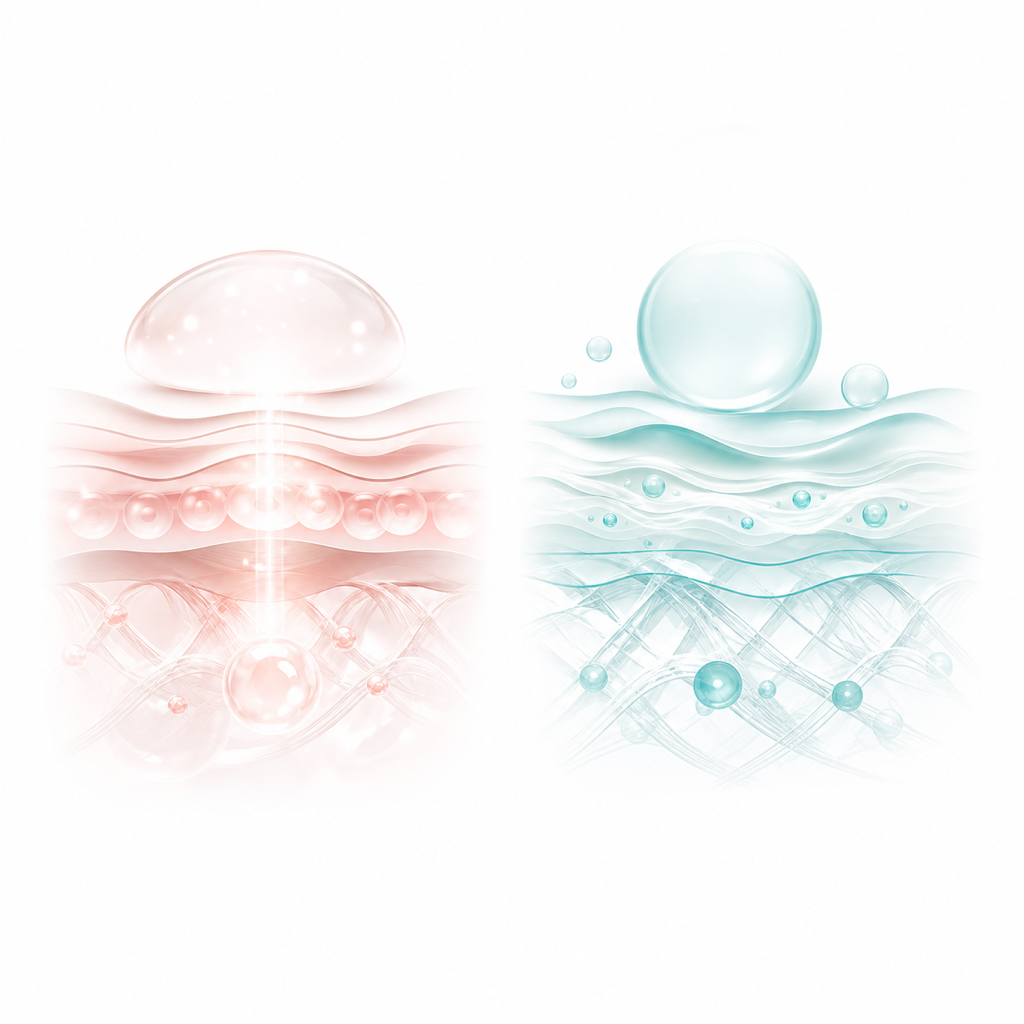
| Comparison item | Rejuran (PN-based) | RITUO (ECM/hADM-based) |
|---|---|---|
| Ingredient origin | PN derived from purified salmon DNA | ECM derived from human tissue (allogeneic dermis) (per the manufacturer's announcement) |
| Main concept of action | Stimulates the skin's own regeneration and collagen synthesis | Directly replenishes ECM components to fill the skin's internal environment |
| Accumulated clinical evidence | Peer-reviewed literature reports exist (PN concentration, mechanism, etc.) | Relatively recently introduced — peer-reviewed evidence is limited, conservative interpretation needed |
| Direction for suitability review | Because ingredients and direction of action differ, the right choice depends on your purpose and skin condition — decided in a prior consultation | |
The two treatments are not a matter of "which one is superior," but a matter of which direction of action better fits your skin concerns and goals. Because the directions of action differ, depending on the situation you might choose just one, or you might review a combination in a coordinated sequence.
5. Downtime & Recovery Comparison

Both RITUO and Rejuran, given the nature of injection treatments, can cause temporary swelling, redness, or bruising, and you may feel a small textural change where the product was injected right after the treatment. Downtime is generally described as short, but the recovery pattern varies widely by individual recovery capacity, lifestyle, and treatment area.
Within 24 Hours After Treatment
- Please avoid irritating cosmetics, hot heat, and vigorous cleansing
- It's best to start light makeup while watching the condition of the treated area
- If your condition changes, please feel free to contact Cellinique
One Week After Treatment
- Please refrain from saunas, jjimjilbang (Korean dry saunas), and intense exercise
- Please apply sun protection thoroughly
- It's best to cut back on alcohol and smoking if possible
Because RITUO is human-tissue-based, suitability and safety assessment is especially important. For both treatments, pregnancy/breastfeeding, active infection, use of anticoagulants or immunosuppressants, autoimmune disease, and ingredient allergies are subject to careful review, so please let us know in advance during the consultation. The side-effect, emergency-response, and contraindication standards common to all treatments can be found on the Cellinique Treatment Safety Information page.
6. How Do You Choose by Purpose?

At Cellinique, we distinguish the two treatments from the perspective of "which direction of action fits you" rather than "which product is more popular." The following is general guidance to aid understanding; the actual choice is decided in a prior consultation based on your individual conditions.
- If you prefer an ingredient with MFDS medical-device licensing and accumulated clinical evidence — Rejuran (PN) is often reviewed first.
- If you want to center on the skin's own regeneration and recovery — PN-based Rejuran is frequently discussed.
- If you're interested in the newer approach of directly replenishing ECM components — we recommend reviewing RITUO as well, but only after fully understanding that the evidence is relatively limited before deciding.
- If you'd like to consider both directions — because the directions of action differ, a combination designed in a coordinated sequence can be reviewed in the consultation.
What matters is not "which one is better," but which direction better fits your skin condition, goals, and sensitivity. That judgment is made together in a prior consultation, after Dr. Kim Gun-woo directly assesses your skin condition.
Frequently Asked Questions (FAQ)
Q1. Which is better, RITUO or Rejuran?
We can't tell you that "one is simply better than the other." Rejuran works in the direction of stimulating the skin's own regeneration, based on PN (derived from salmon DNA), while RITUO works in the direction of directly replenishing human-tissue-derived ECM components, so the very concept of action differs. The right choice depends on your skin condition and goals, so we recommend deciding together in a prior consultation.
Q2. Specifically, how do the ingredients of the two treatments differ?
Rejuran's core ingredient is PN (polynucleotide) extracted and purified from salmon DNA, with a concentration stated as 20 mg/mL per MFDS device-product information / product information (IFU). RITUO, per the manufacturer's announcement, processes human-tissue-derived acellular dermal matrix (hADM) to replenish ECM components such as collagen, elastin, and fibronectin. The ingredient origin and direction of action differ.
Q3. Are both treatments MFDS-licensed?
Rejuran received MFDS medical-device licensing in 2014 (license No. 14-825, tissue-repair biomaterial, PharmaResearch). RITUO, according to reports, is known to be classified and managed/distributed as human tissue without separate clinical trials or device licensing, rather than under medical-device licensing, so the regulatory classification differs. We recommend asking about the exact registration form during the pre-treatment consultation.
Q4. When can I start to feel the effect, and how long does it last?
Both treatments are not completed immediately after the procedure but are treatments where you observe gradual change over time. The degree of change and how long it lasts vary widely by each person's skin condition, age, and lifestyle, so it's difficult to guarantee the same result or a fixed duration for everyone. We recommend asking what you can reasonably expect during a prior consultation.
Q5. Can I receive RITUO and Rejuran together?
Since these are two treatments with different directions of action, a combination can be reviewed depending on the situation, but it should be designed with proper intervals and sequence rather than "piling them up" at the same time — that's safer. Whether it's possible depends on the treatments you're currently receiving, the medications you're taking, and your skin condition, so we coordinate it together in a prior consultation.
Q6. I hear RITUO is a relatively new treatment — is it safe?
RITUO is a relatively recently introduced treatment, so peer-reviewed clinical evidence has not accumulated to the degree Rejuran's has, and it has the characteristic of being human-tissue-based. We can't say that "because it's natural or human-derived, there's no risk at all"; as with any other medical treatment, a prior consultation, suitability assessment, and disclosure of possible side effects are necessary. When we discuss RITUO at Cellinique, we explain it more conservatively and conduct individual assessments with particular care.
Closing
RITUO and Rejuran are not a matter of choosing "the one that is simply better," but a matter of finding, among two options with different directions of action, the one that fits your skin and goals. Rejuran can be summarized as a PN-based regeneration direction with MFDS medical-device licensing, and RITUO as a relatively new direction that directly replenishes human-tissue-derived ECM.
At Cellinique (Gangnam, Dosan-daero), Dr. Kim Gun-woo personally handles everything from the first consultation through the treatment and follow-up checks. If you're curious about both treatments, start with a consultation where you can comfortably talk through your skin condition and care goals. Detailed information on each treatment can be found in the Complete Guide to Rejuran Healer and the Complete Guide to RITUO Skin Booster, and the common safety standards in the Cellinique Treatment Safety Information.
Please Note
- Individual variation: Results, longevity, and suitability vary by each person's skin condition, age, and lifestyle, and the same result cannot be guaranteed.
- Possible side effects: Treatments carry the possibility of side effects such as temporary erythema and swelling, and contraindications may apply, so these are checked in a prior consultation.
✅ Fact-check completion report
The medical information in this article was verified against the following sources:
1. Ministry of Food and Drug Safety (MFDS) — Rejuran medical-device licensing (license No. 14-825, 2014, tissue-repair biomaterial, PharmaResearch Co., Ltd.) · nedrug.mfds.go.kr
2. MFDS device-product information / PharmaResearch product information (IFU) — Rejuran's PN derived from purified salmon DNA · PN concentration 20 mg/mL · nedrug.mfds.go.kr
3. Int. J. Mol. Sci. 2025 (PMC12429772) — PN is reported to promote collagen synthesis and extracellular matrix (ECM) recovery (via a macrophage-mediated pathway)
4. Medi:Today · Seoul Economic Daily reports (citing L&C Bio's announcement) — RITUO = ECM product based on human-tissue-derived hADM (Elaviae RITUO), ECM component composition, classified and distributed as human tissue without separate clinical trials or device licensingKey verification items: ✓ Rejuran ingredient (PN / salmon DNA, 20 mg/mL — per MFDS device-product information / IFU) ✓ Rejuran MFDS medical-device licensing · license No. 14-825 ✓ PN collagen/ECM promotion mechanism (PMC12429772) ✓ RITUO hADM/ECM composition (citing the manufacturer's announcement) ✓ Difference in regulatory classification between the two treatments ✓ Individual variation and side effects stated.
FACTCHECK TODO (definitive statements held until primary sources are verified):
- RITUO's exact MFDS registration form (human-tissue classification vs. raw-material registration vs. medical device) needs direct verification against primary databases (MFDS human tissue / medical device). It is currently described only as "classified as human tissue" based on press reports (citing the manufacturer's announcement).
- RITUO's ECM component composition and effects are based on the manufacturer's announcement and press reports rather than primary peer-reviewed clinical evidence → softened to "reported / described."
- Claims of RITUO's FDA listing / AATB accreditation are from the manufacturer's announcement, so they are not stated definitively in the body (omitted pending verification).
Medical Disclaimer
This content is intended for general health information purposes, and individual diagnosis, treatment suitability, and expected effects must be determined through a prior consultation with a physician. Every medical treatment carries individual variation and the possibility of side effects.
Cellinique Consultation & Booking
2F & B1, Yeonseung Building, 228 Dosan-daero, Gangnam-gu, Seoul
Phone 02-6203-3434
Hours: Mon–Fri 10:00–19:00 / Last Saturday of each month 10:00–16:30