
For Those Curious About the RITUO (Re2O) Skin Booster
If you've been researching skin boosters, you've probably come across the name "RITUO (Re2O)" at least once. Because it's described as "not stimulating collagen production, but directly replenishing already-formed ECM," it's a treatment that often comes up alongside keywords like "fourth-generation skin booster" and "ECM booster." Yet when you actually ask "what exactly is it made of, and how is it different from existing skin boosters," organized information can be surprisingly hard to find.
Today we'll walk through how Cellinique, on Dosan-daero in Gangnam, consults on the RITUO (Re2O) skin booster and how we approach the treatment flow. RITUO is a relatively new category, so publicly verifiable data is still limited. For that reason, in this article we'll separate confirmed facts, presented with their sources, from the parts that are still hard to state definitively, which we frame as information confirmed during consultation. If you're curious about other treatments often reviewed alongside it, see our Complete Guide to Rejuran Healer and Complete Guide to Skin Boosters as well.
Summary
1. RITUO (Re2O) is an ECM-replenishment-class skin booster that uses ECM (extracellular matrix) derived from human acellular dermal matrix (hADM). Rather than "stimulating" collagen production, it is described as directly replenishing already-formed ECM components. It was originally developed by L&C Bio, is supplied domestically by Huons, and launched in November 2024.
2. Because its core raw material is derived from donated human tissue (allogeneic), unlike ordinary fillers and HA boosters it falls within a category handled under Korea's Human Tissue Safety and Management Act and Korea's MFDS oversight framework.
3. As a relatively new category, its ingredient ratios, duration, and long-term data still have limited published primary evidence, so we don't state them definitively. Suitability, expectations, and the number of sessions vary widely from person to person and are decided during a prior consultation.
1. What Is RITUO (Re2O)? A New Approach Centered on hADM and ECM Replenishment
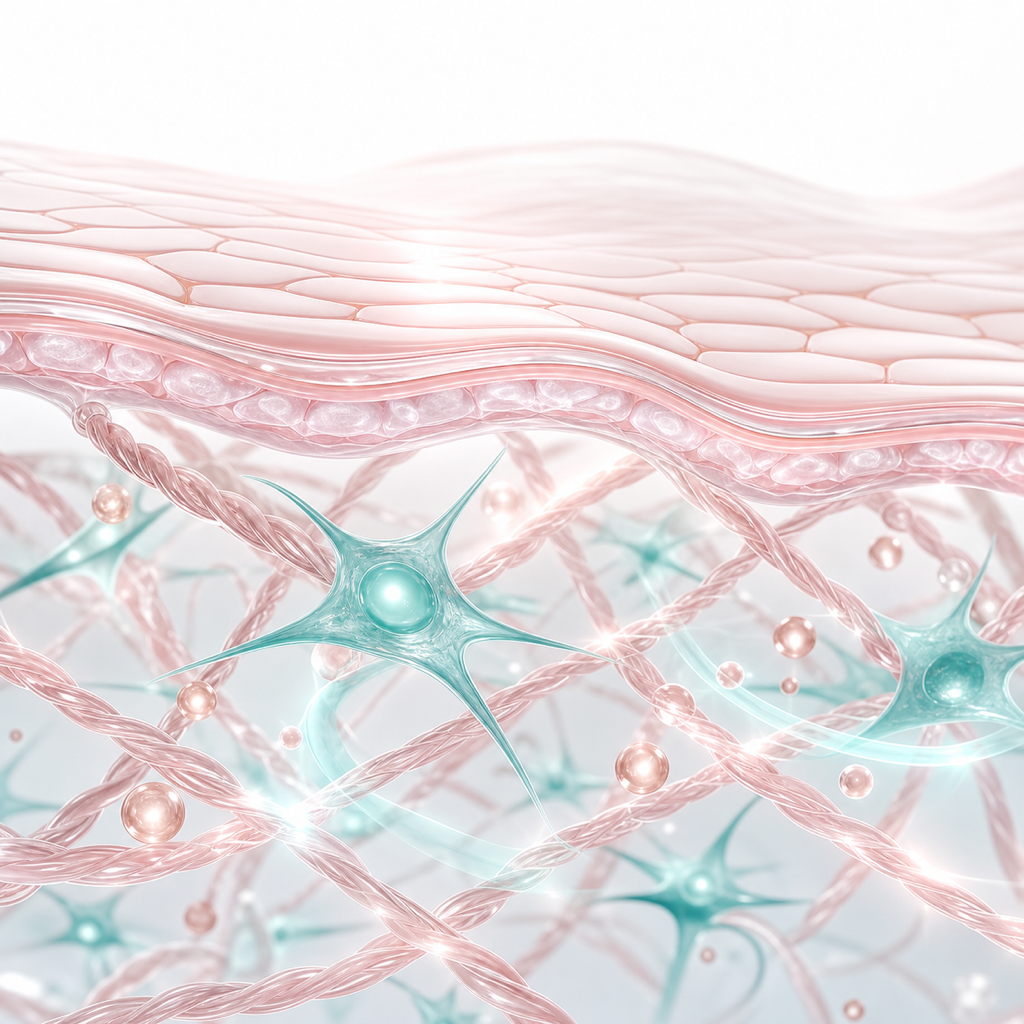
RITUO (Re2O) is a skin booster that uses ECM (extracellular matrix) obtained from human acellular dermal matrix (hADM). Here, ECM refers to the mesh of structural components such as collagen and elastin that make up the dermis, while hADM is a material made by removing the cellular components that can trigger immune rejection from donated human skin tissue, leaving only the ECM structure.
What distinguishes it from existing skin boosters is its direction of action. Where many skin boosters work by "stimulating the skin so it produces collagen on its own again," RITUO is described as directly replenishing already-formed ECM components into the dermis. For this reason, it's often compared as the difference between "waiting for collagen production" and "directly filling in ECM."
That said, because it's a new category, it isn't appropriate to conclude that "directly replenishing it makes it automatically better." It's a different approach, not a superior one, and which direction suits your skin depends on your skin condition, concerns, and treatment history. At Cellinique, we view RITUO as "one option among several," and we assess suitability during a prior consultation.
💡 Fact-check ✓
Sources: L&C Bio official · coverage by The Korea Economic Daily, Seoul Economic Daily, and Pharm News (2024.11)
- RITUO (Elravie RITUO, Elravie Re2O) is reported as an ECM-replenishment-class skin booster that applies human acellular dermal matrix (hADM). It was originally developed by L&C Bio, a company specializing in human tissue regeneration, with domestic supply (distribution rights) held by Huons, and it launched in November 2024.
- L&C Bio's patented human tissue processing technology, "Alloclean Technology," is described as preserving the tissue's three-dimensional structure while removing the factors that cause cellular and immune rejection.
- Rather than "stimulating collagen production," it is presented as an approach that directly replenishes ECM components, with results and perceived effect varying from person to person.
| Category | RITUO (hADM · ECM replenishment) | Stimulation-type skin boosters (e.g., PN · PDLLA class) |
|---|---|---|
| Core approach | Directly replenishes ECM components into the dermis | Stimulates the skin to produce collagen on its own |
| Material class | ECM derived from human acellular dermal matrix (hADM) | PN (salmon DNA-derived) · PDLLA and other synthetic/biomaterials |
| Regulatory framework | Human-tissue (allogeneic) derived — under Korea's Human Tissue Safety and Management Act | Medical device (biomaterial for tissue repair), etc. |
In one line
RITUO is a new-approach skin booster that directly replenishes ECM obtained from hADM. Compared with stimulation-type options, it's a difference in method, not a question of superiority, and suitability is decided during a prior consultation.
2. RITUO (Re2O) at a Glance
| Item | Guidance |
|---|---|
| Ingredient class | ECM replenishment material derived from human acellular dermal matrix (hADM) |
| Care direction | Toward skin texture and skin condition through direct ECM replenishment |
| Original developer / supplier | L&C Bio (original developer) · Huons (domestic supplier) |
| Anesthesia | Topical cream anesthesia (depending on the treatment area) |
| Downtime | Generally on the shorter side, but swelling, redness, bruising, and temporary texture changes vary widely by individual |
| Pattern of perceived change | Gradual change over time, with large individual variation |
| Recommended number · interval | Decided individually during a prior consultation |
| Examples requiring careful review | Pregnancy/breastfeeding, active infection, anticoagulant/immunosuppressant use, autoimmune disease, ingredient allergy, etc. — assessed during a prior consultation |
※ The above is general guidance; whether RITUO is suitable for you and the specific way it would be carried out can only be decided through a prior consultation. Perceived effect and suitability differ depending on your individual skin and health condition.
3. How Is the ECM Booster Mechanism Explained?
To understand why an ECM-replenishment approach like RITUO is drawing attention, it helps to first look at what ECM is. The ECM (extracellular matrix) is a mesh structure in the dermis that surrounds and supports cells, made up of components such as collagen, elastin, and GAG (glycosaminoglycan). As we age, this mesh is known to become sparser, leading to changes in elasticity and texture.
Academic literature on "skin-derived ECM materials" reports that such ECM materials showed a tendency to support fibroblast survival and migration and to increase collagen and elastin expression in cell and animal studies. However, this is basic and preclinical evidence at the category (ECM material) level, and does not mean that large-scale human clinical results for RITUO as a single product have been established. For that reason, Cellinique explains the mechanism but does not state things in a way that implies "the effect is guaranteed."
💡 Fact-check ✓
Sources: J Microbiol Biotechnol 2025 (PMC12197817) · J Microbiol Biotechnol 2026 (PMC12828126)
- Skin-derived ECM materials (based on decellularized human dermis) have been reported in cell studies to support fibroblast survival and migration and promote wound closure, with a tendency to increase collagen and elastin expression (PMC12197817). In animal implantation studies, no marked immune response or systemic toxicity was observed, as described.
- Another paper reports that skin ECM showed a tendency to act on ECM remodeling, moisture retention (HAS2), and the regulation of melanin-related markers in cell studies (PMC12828126).
- Both sources are basic evidence at the cell and animal stage and are distinct from established human clinical data for RITUO as a single product. Effect and duration vary from person to person.
4. How Much of the Ingredient Composition Has Been Confirmed?
Materials introducing RITUO often mention specific ingredient ratios, such as "about 89% collagen, about 3% elastin, about 0.4% GAG including HA, and other ECM components." To be honest, however, these figures are currently values presented in manufacturing and marketing materials and are not figures that can be confirmed as-is in peer-reviewed papers or in Korea's MFDS published primary data. In news and academic sources, the ingredient ratios were often not specified.
For that reason, in this article we won't treat the ratio figures as if they were "established facts." What is certain is the general direction that RITUO is a material that uses a human-derived ECM structure centered on collagen, and the precise composition and specifications are most accurately confirmed during a prior consultation, based on the product you'll actually receive. As a matter of principle, Cellinique does not state weakly evidenced figures definitively on public pages.
💡 Fact-check ✓
Sources: coverage by Huons and Pharm News · coverage by Medico Pharma · (ingredient ratios are based on manufacturing/marketing materials — primary verification withheld)
- RITUO's core raw material is human acellular dermal matrix (hADM) derived from donated human tissue (allogeneic), an ECM material made by processing someone's donated skin tissue, as reported (Medico Pharma).
- The specific ingredient ratios known as "about 89% collagen, etc." are values presented in manufacturing/marketing materials and are not confirmed as-is in peer-reviewed papers or Korea's MFDS published primary data → not stated definitively in the body.
- The precise composition and specifications may differ by product and lot, so the standard that applies to you is confirmed during a prior consultation.
5. For Which Concerns Do We Review RITUO Together?
RITUO is not a treatment we recommend to "everyone." In actual consultations, we tend to review it together with those who describe the following concerns.
If you have concerns like these
- Those bothered by skin texture and skin quality that isn't what it used to be
- Those concerned about the skin's own condition, such as dryness or fine lines
- Those curious about a direct ECM-replenishment approach beyond the "waiting for collagen production" method
- Those who want to compare several skin booster options by their difference in direction
- Those considering the treatment within a flow of long-term skin quality management rather than a single one-time effect
That said, having these concerns doesn't always mean RITUO is the right answer. It simply means it's one of the options that can be reviewed during a consultation. Actual suitability is decided during a prior consultation, tailored to your individual conditions.
Conversely, we proceed cautiously in these cases
- If you are pregnant or breastfeeding, or planning to be
- If there is an active infection or inflammation in the treatment area
- If you are taking anticoagulants, antiplatelet agents, or immunosuppressants
- If you have a history of autoimmune disease
- If you have a history of allergy to anesthetics (such as lidocaine) or to the ingredients
- If you'd like to decide after hearing a full explanation about a human-tissue (allogeneic) derived material — we'll explain the material's characteristics during consultation
If any of the above applies to you, please let us know in advance during your consultation. We'll confirm whether the treatment can proceed and, if needed, also walk you through care options in a different direction.
6. What Does the Treatment Flow Look Like?
At Cellinique, RITUO is carried out in the following order. Because ECM-replenishment treatments involve area design and recovery-flow management that affect how the result is perceived, we keep the treatment flow simple and stable.

- Prior consultation + skin assessment — We directly review your skin condition, skin texture, past treatment history, medications, and lifestyle. At this stage, we also address whether RITUO is a suitable direction, along with an explanation of the characteristics of a human-tissue-derived material.
- Treatment area and plan design — We review together the areas where an ECM-replenishment approach is suitable, the session plan, and how it combines and sequences with other treatments.
- Anesthesia and preparation — We apply topical cream anesthesia, adjusting the anesthesia method to the area and skin sensitivity.
- Treatment application — Applied to the dermal layer via micro-injection. (Injection depth and volume are designed individually to suit the area and condition.)
- Aftercare + next-session guidance — We guide you on immediate post-treatment precautions, recovery checkpoints, and, if needed, the interval to the next session.
💡 One patient's story — Among those receiving it for the first time, some say, "Because I'd heard in advance that it's an approach that directly replenishes ECM, I was mentally prepared to observe the change over time." That said, recovery and change patterns vary widely by individual, so if you notice a change, please feel free to reach out to Cellinique.
7. How Are Downtime and Recovery Managed?
With RITUO, downtime varies depending on the treatment area and extent. It's generally on the shorter side, but because of the nature of an injection treatment, temporary swelling, redness, or bruising can occur, and right after the treatment you may feel a small palpable texture change at the injection sites. There's variation depending on your individual recovery capacity and lifestyle.
Reactions we commonly mention right after treatment
- Temporary swelling and redness at the treatment area
- Injection marks and light bruising (when they occur, they often resolve within a few days)
- A sensation of small bumps palpable at the injection sites (usually stabilizes over time)
- Temporary tenderness and a tight feeling
Within 24 hours after treatment
- Please avoid irritating cosmetics, intense heat, and aggressive cleansing
- It's best to start light makeup while watching the condition of the treatment area
- If your condition changes, please feel free to contact Cellinique
For one week after treatment
- Please refrain from saunas, jjimjilbang, and intense exercise
- Please apply thorough sun protection
- It's best to cut back on alcohol and smoking if possible
The important point is that not everyone's recovery pattern is the same. That's why the recovery flow and treatment schedule should be reviewed together before the treatment.
8. Safety Standards and Precautions
RITUO is very much a medical treatment, so we can't say "there's no risk at all." In particular, because RITUO uses a material derived from donated human tissue (allogeneic), in Korea it is understood to be processed and managed within Korea's Human Tissue Safety and Management Act and Korea's MFDS oversight framework. Cellinique devotes ample time to consultation, area design, and post-treatment checks, and also explains the material's characteristics during consultation.
Commonly reported reactions
- Temporary swelling, redness, and bruising at the treatment area (mostly resolves within a few days)
- A small nodular feeling and tenderness at the injection sites (usually stabilizes over time)
- Very rarely, infection or allergic reaction, or persistent nodules
When you should contact Cellinique immediately
- Severe swelling, warmth, or redness at the treatment area
- Fever or chills
- A nodule that stays firm for more than two weeks or keeps growing
- A suspected allergic reaction (hives, difficulty breathing, etc.)
What you must tell us before the treatment
- Whether you are pregnant or breastfeeding (including if you're planning to be)
- Medications you're taking (especially anticoagulants, antiplatelet agents, and immunosuppressants)
- Allergy history (including the anesthetic lidocaine)
- History of active infection or autoimmune disease
- Other treatments you've had recently (the interval and sequence may need adjusting)
💡 Fact-check ✓
Sources: coverage by Medical Newspaper · Korea Health Industry Development Institute (KHIDI) human-tissue materials
- Human-tissue-derived materials such as human acellular dermal matrix (hADM) are, in Korea, managed in accordance with Korea's Human Tissue Safety and Management Act and international standards (AATB, etc.), and are processed by human tissue processors licensed by Korea's MFDS, as reported.
- Because RITUO has a different regulatory framework from ordinary synthetic or animal-derived fillers as a human-tissue (allogeneic) derived category, we recommend receiving an explanation of the material's characteristics and the consent process during consultation.
- Side effects, contraindications, and individual variation exist, just as with every treatment.
The side-effect, emergency-response, contraindication, and infection-control standards common to all treatments can be found on the Cellinique Treatment Safety Guide page. If you're considering RITUO, we recommend looking it over before the treatment.
9. RITUO vs. Other Skin Boosters: How Do We Compare?
"Is RITUO better than Rejuran or other skin boosters?" is a question we're asked often. At Cellinique, we look at it from the perspective of "which care direction suits you" rather than "which product is more popular." The table below is general guidance for understanding the difference in direction; individual suitability is decided during consultation.
| Category | RITUO (hADM · ECM replenishment) | Rejuran (PN stimulation-type) | HA glow booster |
|---|---|---|---|
| Core approach | Directly replenishes ECM components | Stimulates skin regeneration and recovery | Supports moisture and the surface |
| Material class | Human allogeneic-derived ECM (hADM) | PN (salmon DNA-derived) | HA (hyaluronic acid) |
| How change is observed | Gradual observation over time | Gradual observation over time | Relatively early sense of hydration |
| Recommended number · interval | Varies by area and individual condition, decided during a prior consultation | ||
If you're curious about a direct comparison between RITUO and the PN class, see our Complete Guide to Rejuran Healer; if you'd like to know about the types of skin boosters overall and how to choose, see our Complete Guide to Skin Boosters. There's no need to insist on a single treatment — a design that combines treatments with different directions in the right sequence can also be reviewed during consultation.
10. How Cellinique Operates RITUO
Cellinique is an anti-aging clinic on Dosan-daero in Gangnam-gu. For treatments that are both a new category and involve human-tissue-derived materials, like RITUO, we believe conservative information delivery and thorough prior explanation are especially important. As a matter of principle, we don't state weakly evidenced figures or exaggerated expressions definitively on public pages, and the precise product standard and suitability are confirmed during consultation.
So we manage the flow continuously, from the prior consultation through treatment and post-treatment checks. RITUO is a treatment whose design changes depending on the area, the plan, and the sequence with other treatments, so having the same medical staff manage the flow continuously is advantageous for observing the recovery process.
Thanks to the Gangnam Dosan-daero location, the fact that follow-up visits and post-treatment checks are convenient is also an advantage for treatments where you observe change over time.
Frequently Asked Questions (FAQ)
Q1. What ingredients exactly is the RITUO (Re2O) treatment made of?
RITUO is presented as an ECM-replenishment-class skin booster that uses ECM (extracellular matrix) obtained from human acellular dermal matrix (hADM). Specific ratios such as "about 89% collagen" sometimes appear in materials, but these are manufacturing/marketing figures and are not confirmed as-is in peer-reviewed papers or Korea's MFDS published primary data. For that reason, Cellinique does not state the ratios definitively and explains the precise composition during a prior consultation.
Q2. How is RITUO different from existing skin boosters?
The biggest difference is the direction of action. Where a stimulation-type option like Rejuran (PN) "induces the skin to produce collagen on its own," RITUO is described as an approach that directly replenishes already-formed ECM. That said, this is a difference in method, not a question of superiority, and to see which direction suits your skin, refer to our Complete Guide to Skin Boosters or look into it during a prior consultation.
Q3. When can I expect to feel the effect, and how long does it last?
RITUO is not a treatment that's complete right after the procedure; it's guided as a treatment where you observe change gradually over time. As a relatively new category, its duration and long-term data still have limited published primary evidence, and the degree of change and how long it lasts vary widely depending on your skin condition, age, and lifestyle. For that reason, it's difficult to guarantee identical results or a set duration for everyone. We recommend receiving thorough guidance on what direction you can expect during a prior consultation.
Q4. It's a human-tissue (allogeneic) derived material — is it safe?
RITUO's core raw material is human acellular dermal matrix (hADM) made by processing donated human skin tissue. In Korea, such human-tissue-derived materials are understood to be processed and managed in accordance with Korea's Human Tissue Safety and Management Act and Korea's MFDS oversight framework, as well as international standards (AATB, etc.). That said, we can't claim "there's no risk at all because it's naturally derived," and like any other medical treatment, it requires a prior consultation, a suitability assessment, and disclosure of possible side effects. We'll also explain the material's characteristics and the consent process during consultation.
Q5. Is one session enough, or do I need several?
It's not a treatment with a fixed "correct number of sessions." The number and interval vary depending on your individual skin condition, goals, area, and treatment plan. As a relatively new category, the standardized recommended number of sessions may differ from source to source, so we'll guide you on an individual plan at your first consultation. Duration, too, is hard to state uniformly, so we don't guarantee the same duration for everyone.
Q6. Can I receive both RITUO and Rejuran?
Because their directions of action differ, there are cases where we review them together with the right sequence depending on the situation. That said, we don't "cram" multiple treatments into the same period; they need to be designed with proper intervals and sequencing to be safe. If you let us know during a prior consultation about treatments and medications you're currently receiving, we'll coordinate them together. If you're curious about Rejuran itself, refer to our Complete Guide to Rejuran Healer.
Q7. I've heard you can feel small bumps after treatment — is that okay?
Because RITUO is a micro-injection method, you may feel a small palpable texture change at the injection sites right after treatment. It usually stabilizes over time, but there's individual variation. If something stays firm for more than two weeks or feels like it's gradually growing, please feel free to contact Cellinique.
Q8. Can I just come in for a consultation?
Of course. Because RITUO is a new category and a treatment involving a human-tissue-derived material, we recommend deciding after understanding it fully through consultation. Regardless of whether you proceed with the treatment, if you'd like just a consultation, please feel free to reach out at 02-6203-3434 or via KakaoTalk. (We'll also let you know about consultation fees when you inquire.)
Closing
RITUO (Re2O) isn't a treatment you receive "just because it's famous"; it's a skin booster with a new approach that directly replenishes hADM-derived ECM. It simply differs in method from stimulation-type skin boosters rather than being superior, and as a relatively new category, parts such as ingredient ratios and duration still have limited published primary evidence, so Cellinique guides them conservatively. What matters isn't product recognition, but whether that care direction actually suits your skin and goals.
At Cellinique (Gangnam Dosan-daero), the same team handles the flow continuously, from the first consultation through treatment and post-treatment checks. If you're interested in RITUO, start with a consultation where you can comfortably talk through your skin condition and care goals. You can find a comparison with stimulation-type skin boosters in our Complete Guide to Rejuran Healer, the types of skin boosters overall and how to choose in our Complete Guide to Skin Boosters, and the common safety standards in the Cellinique Treatment Safety Guide.
Please note
- Individual variation: Results, duration, and suitability differ depending on your individual skin condition, age, and lifestyle, and the same result cannot be guaranteed.
- Possibility of side effects: Treatment carries the possibility of side effects such as temporary erythema and swelling, and there may be contraindications, which are confirmed during a prior consultation.
✅ Fact-check completion report
The medical information in this article was verified against the following sources. Because RITUO is a relatively new category, some items have limited published primary evidence and were therefore expressed conservatively:
1. L&C Bio official · coverage by The Korea Economic Daily, Seoul Economic Daily, and Pharm News (2024.11) — RITUO (Elravie RITUO, Elravie Re2O) is an ECM-replenishment-class skin booster applying human acellular dermal matrix (hADM); originally developed by L&C Bio, supplied domestically by Huons, Alloclean Technology, launched November 2024
2. Coverage by Medico Pharma — that RITUO's ECM raw material is derived from donated human tissue (allogeneic) (processing of human skin tissue)
3. J Microbiol Biotechnol 2025 (PMC12197817) — skin-derived ECM (decellularized human dermis) material shows, in cell studies, a tendency to support fibroblast survival, migration, and wound closure and to increase collagen and elastin expression, with no marked immune response or systemic toxicity observed in animal implantation (category-level preclinical evidence) · pubmed.ncbi.nlm.nih.gov
4. J Microbiol Biotechnol 2026 (PMC12828126) — skin ECM shows a tendency to act on ECM remodeling, moisture retention (HAS2), and the regulation of melanin-related markers (cell studies)
5. Coverage by Medical Newspaper · Korea Health Industry Development Institute (KHIDI) materials — human-tissue-derived materials such as hADM are managed in accordance with Korea's Human Tissue Safety and Management Act and international standards (AATB), processed by processors licensed by Korea's MFDSKey verified items: ✓ definition of hADM · ECM replenishment ✓ original developer/supplier and launch timing ✓ human-tissue (allogeneic) derivation ✓ category-level preclinical evidence for ECM materials ✓ Human Tissue Safety and Management Act regulatory framework ✓ individual variation and side effects stated. Points we don't claim definitively: ① specific ingredient ratios such as "about 89% collagen" (based on manufacturing/marketing materials, not primary-verified) ② the precise Korea's MFDS licensing classification/number (not confirmed in published primary databases) ③ duration and long-term effect figures (limited published primary evidence) ④ large-scale human clinical data for RITUO as a single product (not established).
Medical Disclaimer
This content is intended to provide general health information; individual diagnosis, treatment suitability, and expected outcomes must be decided through a prior consultation with a physician. Every medical treatment carries individual variation and the possibility of side effects.
Cellinique Consultation & Booking
2F & B1, Yeonseung Building, 228 Dosan-daero, Gangnam-gu, Seoul
Phone 02-6203-3434
Hours Mon-Fri 10:00-19:00 / last Saturday of each month 10:00-16:30