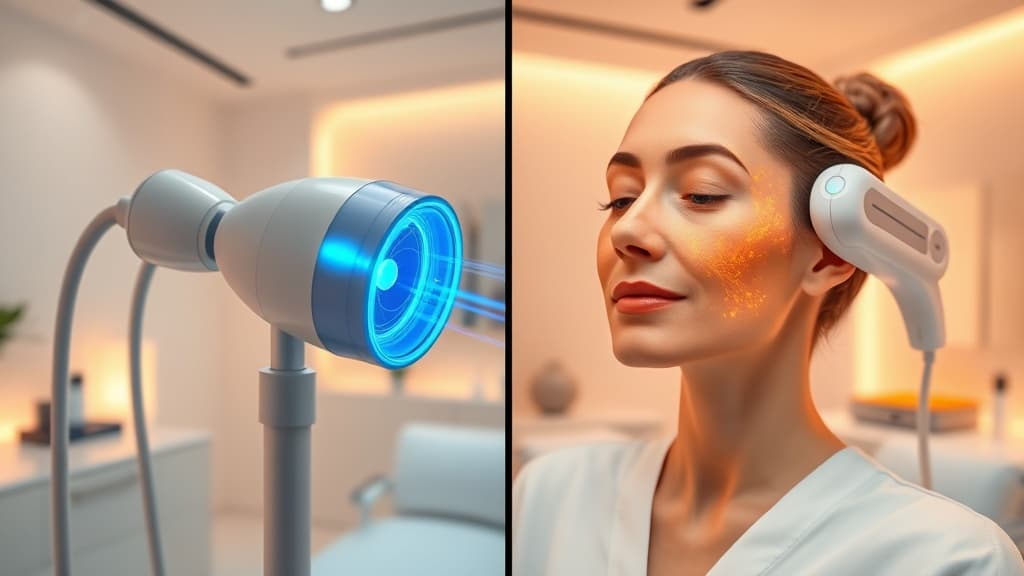
If your main concern is sagging at the brow, under the chin, or on the neck, look at Ultherapy first; for eyelid and eye-area wrinkles, look at Thermage first. Both are nonsurgical lifts, but one uses radiofrequency heat and the other focused ultrasound, and the layer each one heats is different.
At a glance
The choice depends on the area and the concern, not on which device is better.
Ultherapy uses focused ultrasound to place small heat points at set depths. Thermage FLX cools the surface while heating a wider volume.
A pacemaker or similar implanted electronics rules out both. Directly over filler, the two manuals differ.
Sagging or eye-area wrinkles: which device should you consider?
Because sagging and wrinkles often sit in different places, the device to consider first differs too. For a separate account of each device, see the Ultherapy effects guide and the Thermage effects guide.
| Concern | Device to consider |
|---|---|
| Sagging at the brow, under the chin, or the neck | Ultherapy |
| Eyelid and eye-area wrinkles | Thermage FLX |
| Fine lines and texture over the whole face | Thermage FLX (labeled for wrinkles) |
| When pain is a worry | Both devices involve pain during treatment — ask about the anesthetic method beforehand |
| A site that already has filler | Ultherapy advises against treatment directly over filler; Thermage has no study on this — say where the filler is beforehand |
| A pacemaker or other implanted electronics | Neither treatment is done |
| If you want a single session | The studies followed outcomes after a single session |
How do the energy source and labeled uses differ?
Ultherapy (Ulthera) is a focused-ultrasound (HIFU) device that gathers ultrasound into small heat points. During treatment, imaging looks under the skin to confirm that the handpiece is coupled and that bone is avoided. The U.S. FDA premarket summary lists a brow lift, lax tissue under the chin and on the neck, and lines on the upper chest (décolleté).
Thermage FLX sends radiofrequency while cooling the epidermis. The U.S. FDA premarket summary says the tip moves in a stamping motion and that the system monitors skin contact and energy delivery. Preparation involves a marking grid, a return pad, and coupling gel. The labeled use is periorbital wrinkles, including the upper and lower eyelids, and wrinkles elsewhere. Pain, contraindication, and eye-tip details come from the manual for Thermage CPT, which the FDA summary identifies as the previous-generation device. The FLX summary records the labeled use and the cooling, stamping method.
| Item | Ultherapy | Thermage (FLX summary and CPT manual) |
|---|---|---|
| Energy and reach | Focused ultrasound, small heat points at 1.5 mm, 3.0 mm, and 4.5 mm. Imaging to 8 mm | Radiofrequency heats a wide volume and cools the surface |
| Labeled use in the U.S. clearance | Lifting the brow, laxity under the chin and on the neck, upper-chest lines | Periorbital wrinkles including upper and lower eyelids, and other wrinkles |
| Main concern | Sagging contour (brow, under the chin, neck) | Wrinkles, especially eyelids and the eye area |
| Sessions and how much is done at one time | The studies followed outcomes after a single session | How much is done at one time is set by site, tip, and how many times the tip passes |
| Proportion rated as improved, and when | Pooled HIFU review across devices, not Ultherapy-specific results. On 90-day investigator scores, 92% of 337 people improved in tightening or wrinkles. Self-scores in 81 people were 42% at 90 days and 53% at 360 days. Upper-chest photos at 180 days | — |
| During treatment | Brief discomfort as energy is delivered. The review describes moderate pain | Mild to moderate pain during treatment is common. Rarely, an ache lasting several months |
| Right after | Brow, under the chin, neck: redness for hours, swelling from 3 to 72 hours, tenderness for 2 days to 2 weeks, nerve symptoms for 2 to 6 weeks | Redness usually for hours, rarely for weeks. Swelling usually lasts 5 days, and longer cases run for several weeks |
| Eyes and filler | Avoid the eye, eyelid, and bony rim. Directly over filler: not advised | Eyelids are in the labeled use. Use over filler was not studied in people |
※ The investigator rate and the self-reported rate in the table pool focused-ultrasound studies across several devices; they are not Ultherapy's own results. The conclusion covers women with mild to moderate laxity.
What happens on the day, and what sets the time?
Neither treatment cuts the skin surface. What is prepared, and how the energy is delivered, differs. Ultherapy applies gel, checks layers and bone on imaging, then places heat points along the chosen depth. Thermage applies a grid and a return pad, then stamps heat and cooling together with the tip. The time grows with the site and the amount of treatment.
| Step | Ultherapy | Thermage (FLX summary and CPT manual) |
|---|---|---|
| Preparation | Ultrasound gel. Imaging checks coupling and bone | Marking grid, return pad, coupling gel |
| How energy is delivered | Lines at the chosen depth | The tip stamps radiofrequency and cooling together |
| Eye area | Avoid the eye, eyelid, and bony rim | Plastic shield, small tip, vibration off |
| Time | Site, depth, and number of lines | Site, tip, and how many times the tip passes |
For how cleansing, heat, and exercise differ by device type, see the lifting aftercare guide.
When does a change show?
In the focused-ultrasound review, investigators rated improvement higher than patients did. Patients' own ratings from 90 to 360 days describe a mild change. The upper-chest observation looks at photos 180 days after one session. The same review also records that improvement grew smaller as laxity grew more severe.
The Thermage FLX regulatory summary and the CPT manual record the wrinkle indication, surface cooling, and the stamping method. Where those documents mention months, they refer to a skin reaction, not how long results last. Dents and surface unevenness often show from 1 month onward rather than right away, and the manufacturer says to watch for 6 months after they appear. For how nonsurgical lifting is sorted by energy rather than by device name, see the Seoul nonsurgical lifting guide.
How much does it hurt, and who is not treated?
The Ultherapy instructions describe discomfort during energy delivery as momentary. For the brow, under the chin, and the neck, they describe the usual course as post-treatment discomfort settling within 2 hours to 2 days, and tenderness to touch within 2 days to 2 weeks. Redness lasts hours, swelling 3 to 72 hours, and bruising 2 days to 2 weeks. Temporary muscle weakness and tingling last 2 to 6 weeks. A permanent injury to a facial nerve was not reported in the clinical evaluation. The post-market list includes nerve symptoms lasting months, loss of volume, scars, pigment change, and vision change. The same instructions warn that a tilted angle, wrong line spacing, or pooled gel can cause burns and scarring.
The review describes focused-ultrasound pain as moderate, and lists altered sensation, bruising, stinging, burns near the jaw, linear striations, and contact dermatitis at 2%. That figure pools several devices and energy settings. The CPT manual lists mild to moderate pain during Thermage treatment as a common, expected reaction. Discomfort stays in the treated area during the procedure, and a heavy ache rarely lasts several months. Burns, blisters, scabs, scars, surface dents, altered sensation, lumps on the neck, pigment change, bruising, itching, and reactivation of existing herpes are on the same list. Studies in the review used topical anesthetic, oral medicine, or injection, and the choice differed by study. The CPT manual says to wipe anesthetic and cosmetics off the skin before treatment and leave only the coupling gel.
Where filler is already in place, the two manuals differ. Ultherapy advises against treatment directly over filler. The CPT manual records that use over filler was not studied in people. For how to match site and timing, see Ultherapy and Thermage after filler or botulinum toxin.
| Condition | Ultherapy | Thermage |
|---|---|---|
| Metal | Metal implants in the treatment area: contraindicated | Over large dental metalwork, place dry cotton inside the cheek |
| Ultherapy skin contraindications | Open wounds and severe cystic acne: contraindicated | — |
| Thermage skin reactions | — | Burns, blisters, and surface dents |
| Pregnancy, lactation, children | A group left out of the evaluation | A group left out of the evaluation |
| Other groups left out of the evaluation | Bleeding that is hard to stop, skin disease that interferes with healing, herpes, autoimmune disease, diabetes, epilepsy, paralysis of one side of the face | Diabetes, autoimmune disease, herpes, epilepsy |
What three things affect the price?
Three things affect the price: the site (brow, under the chin and neck, upper chest, and whether eyelids are included), Ultherapy depth and line count, and how many times the Thermage tip passes. The eye area adds the small tip and vibration-off conditions. For each device, see the Ultherapy treatment page and the Thermage treatment page.
What should you write down before the consult?
Noting the area of concern and any implanted device helps decide which to consider first.
- □ Whether the concern is the brow, under the chin, or the neck, or eyelid and eye-area wrinkles
- □ A pacemaker or defibrillator, or metal in the treatment area, or large dental work
- □ An open wound, severe cystic acne, pregnancy, or lactation
- □ The site and date of filler, threads, or an energy treatment
- □ Whether your schedule allows for the periods in the instructions (redness for hours, tenderness up to 2 weeks, nerve symptoms up to 6 weeks)
- □ Whether the eyelids are part of the treatment area, and if so, that Ultherapy avoids them and Thermage requires the small-tip conditions
Frequently asked questions
Q1. Does it hurt?
With Ultherapy, discomfort comes in the moment energy is delivered. For the brow, under the chin, and the neck, post-treatment discomfort is listed as 2 hours to 2 days, and tenderness to touch as 2 days to 2 weeks. The review describes focused-ultrasound pain as moderate. The CPT manual lists mild to moderate pain during Thermage as a common reaction, and rarely an ache in the treated area for several months.
Q2. How many sessions?
Studies gathered in the focused-ultrasound review, and the upper-chest observation in the Ultherapy instructions, each used a single session. The upper-chest photos are at 180 days after that session. How much Thermage does at one time is set by site, tip, and how many times the tip passes.
Q3. When do you check for a change?
Investigator scores at 90 days were higher than patients' own scores, and patients' own ratings from 90 to 360 days describe a mild change. Upper-chest photos are at 180 days after one session. In the Thermage documents, the timeframe given in months refers to surface dents: they show from 1 month onward, and the manufacturer says to watch for 6 months after that.
Q4. What if I care about both the jawline and the eyelids?
Ultherapy's U.S. labeled uses include lifting the brow and lax tissue under the chin and on the neck. The eyelids are in the Thermage labeled use, and they are an area the Ultherapy instructions say to avoid. Where filler is present, Ultherapy advises against passing over it, and the Thermage CPT manual records that this use was not studied.
Q5. Can the eye area be treated?
The Ultherapy instructions say to avoid the eye, the eyelid, and the bony rim around the eye. The Thermage regulatory summary lists periorbital wrinkles, including the upper and lower eyelids, as a labeled use. The CPT manual attaches a plastic eye shield, the small tip, and vibration off as conditions for that treatment.
Sources
- U.S. FDA: Ulthera System premarket summary
- U.S. FDA: Thermage FLX premarket summary
- Ulthera: Ultherapy instructions for use
- Solta Medical: Thermage CPT technical user manual
- Contini M et al. (2023), Int J Environ Res Public Health: A Systematic Review of the Efficacy of Microfocused Ultrasound for Facial Skin Tightening (PMID 36674277)
This article is general information and does not replace individual medical care.
Discuss options for your current needs
We review your current health and prior procedures before explaining appropriate options and their limits.