
THERMAGE
Thermage FLX is a no-incision lifting treatment that heats the dermis with radiofrequency while cooling the skin. Energy delivery takes about 30-60 minutes.
WHAT WE CHECK IN CONSULTATION
Those bothered by fine lines on the eyelids and around the eyes
Those looking for a lifting treatment without incisions
Those who want to address cheek and jawline wrinkles along with the eye area
Those comparing Ulthera and Thermage to see which one fits
TREATMENT OVERVIEW
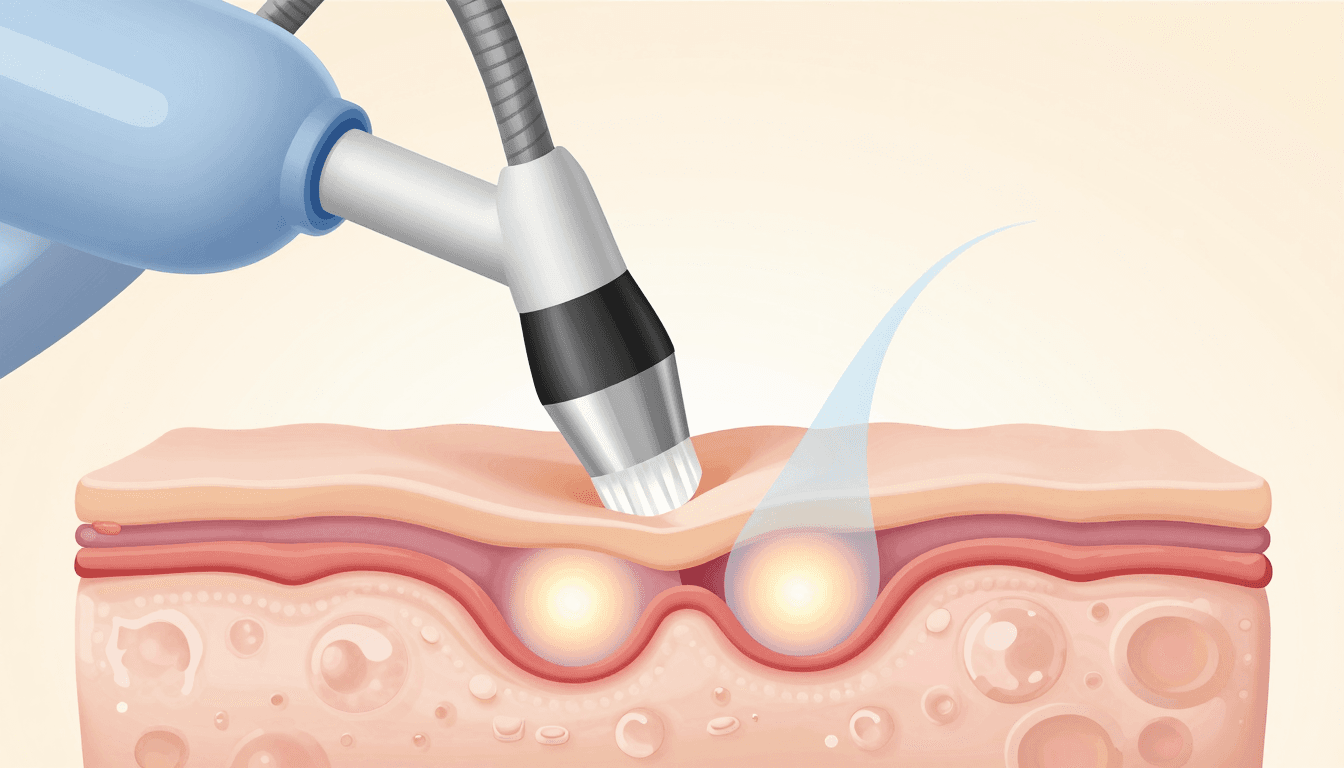
The tip cools the skin surface while radiofrequency current heats a broad area of the dermis. In early tissue studies, collagen fibers contracted right after treatment, and signals for making new collagen increased afterward.
A multicenter study that treated the eye area once with an early device measured changes in wrinkle scores and eyebrow position for 6 months. In a survey of Korean dermatologists who use Thermage FLX, more than half said they set the retreatment interval at 1 year.
View detailed information
What is Thermage FLX?
Thermage FLX is a lifting treatment that sends radiofrequency heat into the dermis while cooling the skin surface. It involves no incisions and treats facial wrinkles, including the eyelids and the eye area. The uses U.S. regulators cleared for this device are also wrinkles around the eyes, including the upper and lower eyelids, and other wrinkles. It is the device to look at first when your main concern is wrinkles, especially around the eyes, rather than sagging contours.
How does radiofrequency heat work in the skin?
The radiofrequency current flows from a tip placed on the face and returns through a pad attached to the body. This setup is commonly called monopolar radiofrequency. While the current heats a broad area of the dermis, the tip cools the epidermis to protect the skin surface.
In early tissue studies, collagen fibers contracted right after treatment, and signals for making new collagen increased afterward. Studies in people also observed both immediate tightening and changes over the following months. For study-by-study details, see Thermage research, pain, and side effects.
How many sessions, and how long were changes tracked?
Studies that measured changes with Thermage are based on a single session. A multicenter study that treated the eye area once with an early Thermage device followed patients for 6 months. On independent grading, wrinkle scores dropped by one grade or more in over 8 of 10 treated areas. The eyebrows rose by 0.5 mm or more in 6 of 10 areas, and half of the patients said they were satisfied with the change in their eye-area wrinkles.
For retreatment timing, a survey of Korean dermatologists who use Thermage FLX offers a reference point. More than half said they set the retreatment interval at 1 year, and the doctors named skin thickness as an important factor in how the skin responds.
Note: The wrinkle and eyebrow figures come from a study of the eye area using an early device. That study graded results only up to 6 months.
How long does it take, how much does it hurt, and what is recovery like?
Energy delivery takes about 30-60 minutes, plus about 10-20 minutes beforehand for cleansing and preparation. The steps are:
- Consultation and cleansing
- Marking a grid on the treatment area
- Attaching the pad the current returns to
- Delivering energy area by area, one tip placement at a time
- Checking the skin right after treatment
You will feel heat and pressure during treatment. The manufacturer's instructions list mild to moderate pain as a common response. If the burning sensation builds, say so right away, and the provider will lower the energy to match. In the survey of Korean doctors, 2 in 3 said FLX takes less time than the previous device, and 1 in 4 said it hurts more.
Redness usually fades within a few hours, and swelling usually settles within 5 days. The instructions also note rare cases that lasted several weeks.
Note: The pain, redness, and swelling durations come from the manufacturer's instructions for the previous-generation device.
What reactions have been reported, and who should postpone?
Reported reactions to Thermage include burns and fat atrophy. Second-degree burns occurred in the multicenter eye-area study, and some patients still had small scars at 6 months. In data that tracked 290 people, second-degree burns, fat atrophy, and burns where the pad was attached appeared in a portion of treatment sessions.
- Common: heat, temporary redness and swelling
- Rarely reported: second-degree burns, small scars, fat atrophy
- Other reactions listed in the instructions: blisters, crusting, surface depressions, changes in sensation, pigment changes, bruising, itching
Surface depressions often show up 1 month or more after treatment rather than right away. The technique has also changed. Early on, the device made a single pass at high energy; later, the approach shifted to multiple passes while asking the patient about heat.
Let us know before booking if any of the following applies:
- Implanted electronic devices such as a pacemaker: the current passes through the body to the pad, so treatment is not performed.
- Pregnancy or breastfeeding: these groups were left out of device evaluations.
- Metal or filler in the treatment area: the manufacturer states in its instructions that use over filler has not been studied in people.
How is it different from Ulthera?
Thermage uses radiofrequency heat, while Ulthera uses ultrasound focused on one point. Because the energy differs, the layers the heat reaches and the cleared uses differ too.
| Thermage FLX | Ulthera | |
|---|---|---|
| Energy | Radiofrequency heats a broad volume while cooling the surface | Focused ultrasound makes small heat points at 1.5 mm, 3.0 mm, and 4.5 mm depths |
| U.S. cleared uses | Wrinkles around the eyes, including upper and lower eyelids; other wrinkles | Brow lift, sagging under the chin and on the neck, wrinkles on the upper chest |
| Main concern | Wrinkles, especially the eyelids and eye area | Sagging contours (brows, under the chin, neckline) |
| Eyelids | Within the cleared use | Avoids the eyes, eyelids, and bony rim around the eyes |
| Areas with filler | Not studied in people by the manufacturer | Not recommended directly over filler |
| What sets the treatment amount | Area, tip, number of tip passes | Area, depth, number of lines |
In a 20-person trial comparing the two energies on opposite halves of the face, sagging scores did not differ between sides through 6 months. Which device to choose comes down to the area and the concern. Contraindications and recovery times for each device are laid out in a table in Ulthera vs. Thermage.
What to check at your consultation
Cellinique first reviews skin laxity, pain sensitivity, past treatments, and your goals before deciding whether Thermage is right for you. At the consultation, go over these 5 points together:
- □ Whether the device used is Thermage FLX
- □ Which areas will be treated (eye area, cheeks, jawline) and whether the eyelids are included
- □ What rule is used to lower the energy when heat builds during treatment
- □ Whether you have disclosed implanted electronic devices, metal, pregnancy or breastfeeding, and filler locations
- □ How progress will be compared after 6 months
01
Cools the surface, heats below
The tip cools the epidermis while sending radiofrequency heat into the dermis. No incisions are made.
02
Cleared for use up to the eyelids
U.S. regulators cleared it for wrinkles around the eyes, including the upper and lower eyelids, and for other wrinkles.
03
Progress after one session
The eye-area study measured changes for 6 months after one session. In a doctor survey, more than half set retreatment at 1 year.
TREATMENT PROCESS
Consultation
Skin condition, prior procedures, and treatment goals are reviewed to assess suitability.
Preparation
The treatment area is cleansed and prepared, with marking or protective steps if needed.
Energy-based treatment
RF-based treatment is delivered according to the planned area and settings.
Aftercare guidance
The skin is checked and instructions are given regarding daily activity, irritation avoidance, and follow-up.
Before and After Treatment
Before treatment
During consultation, we review your current health, medications, allergies, pregnancy or breastfeeding status, and previous procedures.
Aftercare
Follow the procedure-specific guidance on irritation, heat, alcohol, exercise, and sun exposure, and contact the clinic if you notice an unexpected symptom.
Preparation and aftercare vary by procedure and individual health status. Please follow the instructions given during your consultation.
Consulting physician · Dr. Chris Gunwoo Kim · Director, Laboratory Medicine specialist
Frequently Asked Questions
Does Thermage FLX hurt a lot?
You will feel heat and pressure. The manufacturer's instructions list mild to moderate pain during treatment as a common response, and also note rare cases of dull pain lasting several months. In data that tracked 290 people, a little over 1 in 10 sessions was recorded as especially painful.
How many Thermage sessions do I need?
Studies that measured changes are based on a single session. In a survey of Korean dermatologists who use Thermage FLX, more than half said they set the retreatment interval at 1 year. Whether to repeat is decided after comparing progress from the first session.
When do Thermage results show, and how long do they last?
Both immediate tightening and changes over the following months have been observed. The multicenter eye-area study graded results only up to 6 months, so it cannot tell us how long results last beyond that.
How long do redness and swelling last after treatment?
Redness usually fades within a few hours, and swelling usually settles within 5 days. Surface depressions or unevenness often show up 1 month or more after treatment rather than right away, and the manufacturer advises watching for 6 months after a depression appears.
Can Thermage be used on the eyelids?
Yes. Wrinkles around the eyes, including the upper and lower eyelids, are within this device's cleared use. For eyelid treatment, plastic eye shields are placed, a small tip is used, and the vibration feature is turned off.
Can I get Ulthera on the same day?
One study gave both energies in sequence in a single session. 22 Korean adults received radiofrequency and focused ultrasound back to back and had their faces assessed at 20 weeks. Because everyone received both, the study cannot show whether combining them does more than either one alone. Whether to do both on the same day is decided by looking at where you were treated before.
Can I get it on areas with filler?
The manufacturer states in its instructions that use over filler has not been studied in people. If you have filler in the same area, the order and spacing of heat treatment are decided first, so bring a note of where and when you had filler.
Who should not get Thermage?
Treatment is not performed if you have an implanted electronic device such as a pacemaker. People who are pregnant or breastfeeding, and those with diabetes, autoimmune disease, or epilepsy, were left out of device evaluations, so let us know before booking.
Treatment Safety
For the shared standards on side effects, emergency response, contraindications, and infection control that apply to every Cellinique treatment, please refer to the Cellinique Treatment Safety Guide. This page covers information specific to this treatment.
View Treatment Safety GuideRelated Treatments
Explore other options in the same category that are often compared alongside this treatment.


Related guides
Guides that cover this treatment in more detail.
- Thermage Results: How It Works, Pain and Side EffectsExplore how Thermage works, results, pain and risks. Compare early-device studies with FLX surveys and learn what to check before treatment.
- Ultherapy (Ulthera) vs Thermage: How the Devices DifferCompare focused ultrasound and radiofrequency side by side. Read what each device uses, what the studies measured, and what to ask before a consultation.
- Seoul nonsurgical lifting: HIFU and radiofrequency consultation criteriaNonsurgical lifting in Seoul: HIFU heats set points at depth, radiofrequency heats the dermis more broadly. See reactions and what to ask in consultation.
- Why Does Skin Elasticity Decline? Slowing It and Choosing a ProcedureCan lost skin elasticity be restored? See why collagen and elastin wear down, how to slow it at home, and two procedure groups that support the skin.
- Had filler or botulinum toxin before? What to tell your Ulthera or Thermage consultationPrior filler or botulinum toxin history can change Ulthera (HIFU) and Thermage (radiofrequency) planning. Cellinique Clinic on Apgujeong Dosan-daero explains how to record what you had, when, where, and how you responded — and what international consensus says about combination procedures.
- Jowls: Why They Form and Which Non-Surgical Lifting Treatments Address ThemJowls form beside the mouth, on the jawline. See why that tissue sags, what Ulthera, Thermage FLX, and Tune Face address, and what lifting studies found there.

CELLINIQUE
Start your journey to timeless beauty today.