
GOURI
GOURI injects liquid PCL into the face to soften wrinkles and folds. One session is standard; 1–2 more 4–6 weeks apart if severe. First changes at 1–2 weeks.
WHAT WE CHECK IN CONSULTATION
People bothered by facial wrinkles and folds
Those looking for an injection that spreads across the face rather than filling one spot
Those who want a treatment plan that starts with one standard session
Those who want to compare the materials in GOURI, Profhilo, and Re2O
TREATMENT OVERVIEW
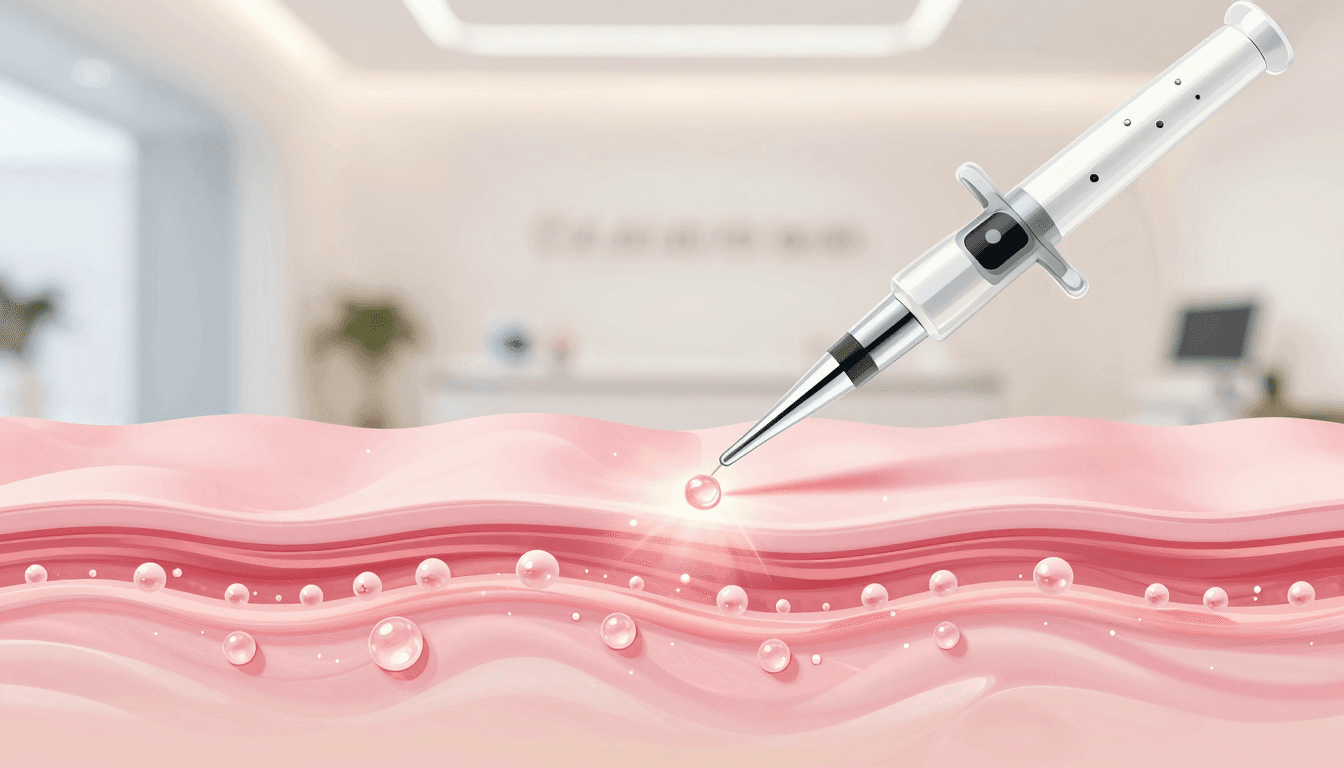
GOURI is an injection made from PCL, a polymer also used in sutures, dissolved in water with no particles so it spreads across the face after injection. The manufacturer says that as the spread PCL breaks down, it stimulates the cells that produce collagen.
The first changes are checked around 1–2 weeks after treatment, and what you see right after the injection is mostly swelling. The material takes 6–12 months to break down in the body, but that number does not mean how long the effect lasts.
View detailed information
What is GOURI?
GOURI is a skin booster made by dissolving a polymer called polycaprolactone (PCL) in water and injecting it into facial skin. PCL has been used in medical materials such as sutures, and GOURI turns it into a particle-free liquid. The manufacturer is Dexlevo, and the product information lists its use as correcting moderate to severe facial wrinkles and folds.
Particle-based fillers are used to build volume in one spot. GOURI is an injection designed to spread across the face after it goes in, so its purpose is different from treatments that fill a specific area.
How does liquid PCL work in the skin?
According to the manufacturer, as the PCL spreads through the skin and breaks down, it stimulates the cells that produce collagen. The syringe contains 21% liquid PCL, and it is injected into the dermis or the subcutaneous layer.
Being a liquid also affects how it is injected. With particle-based PCL fillers, the particles can clog the needle or clump on one side. GOURI is dissolved in water, so it can be injected through a fine needle.
The material takes 6–12 months to break down in the body. That number is only the breakdown time. It does not tell you how long the effect lasts.
How many sessions, and how far apart?
One session is standard. The product is injected at 10 points across the face, and for more severe wrinkles or folds, 1–2 more sessions are added at 4–6 week intervals. The product information also notes that additional injections are needed to maintain the improvement, so your next visit is planned at the first session.
The first changes are checked around 1–2 weeks after treatment. What looks different right after the injection is mostly swelling, so results are not judged at that point.
Treatment time, pain, and what happens on the day
The injection takes about 20–30 minutes. The whole visit, including consultation and aftercare instructions, takes about 30–60 minutes. Because a needle is used, you will feel a sting, and local anesthesia is applied first if needed.
- Consultation: Your skin condition, recent facial treatments, and current medications are reviewed, and the injection points are chosen.
- Disinfection and anesthesia: The skin is disinfected, and local anesthesia is applied as needed.
- Injection: The product is injected in portions at the planned depth, and the treated areas may be smoothed with the fingertips.
- Post-treatment check: Bruising, redness, and swelling are checked, and you are told when you can go back to makeup and saunas.
Possible reactions and recovery
Common reactions listed in the product information are bruising, redness, swelling, pain, tenderness when pressed, itching, and a lumpy feeling (nodules). These usually settle within 1–2 weeks. Swelling can appear within 72 hours of treatment, or show up later, 1–2 weeks afterward. In rare cases, bruising has lasted for months, and 7 such cases have been reported. They occurred under the eyes, at injection marks, and on the upper arm, and cleared up with later treatment.
Inflammation, infection, and hypersensitivity reactions can also occur. If warmth increases or redness spreads, get seen the same day to check for infection. If the product enters a blood vessel, it can lead to tissue necrosis or vision damage. For this reason, the product information gives a specific caution for areas with many blood vessels, such as the eyelids and the area around the eyes.
- Makeup: after 12 hours
- Strenuous exercise, alcohol: avoid for 1–2 days
- Saunas, strong UV exposure: avoid for 2 weeks
- Laser, chemical peels: schedule on a different day
According to the product information, GOURI is not used for people who are pregnant or breastfeeding, under 19, hypersensitive to PCL, have severe allergies or a bleeding tendency, take anticoagulants or immunosuppressants, or have an autoimmune disease or a tendency toward hypertrophic scarring.
How is it different from Profhilo and Re2O?
The three treatments differ starting with what is in the syringe. GOURI is liquid PCL, Profhilo is high-concentration hyaluronic acid, and Re2O is dermal particles from donor skin with the cells removed. Session counts and intervals are also set differently for each product.
| Item | GOURI | Profhilo | Re2O |
|---|---|---|---|
| Material | 21% liquid PCL, particle-free | 64 mg hyaluronic acid per 2 mL, no chemical cross-linker | 150 mg decellularized dermal particles |
| Manufacturer | Dexlevo | IBSA | L&C Bio |
| Sessions and interval | 1 standard; 1–2 more at 4–6 week intervals for severe cases | 2 sessions 30 days apart, then optional maintenance every 2 months | 3 sessions one month apart in clinical trials |
| Injection site | 10 points on the face, dermis or subcutaneous | 5 points on each side of the face, dermis to subcutaneous | Mid-dermis |
| Known common reactions | Bruising, redness, swelling, pain | Bruising, swelling, stinging, small bumps | Temporary redness, mild swelling |
The product information also sets rules for combining GOURI with other treatments. Botulinum toxin or non-cross-linked skin boosters can be given on the same day as GOURI. Cross-linked hyaluronic acid fillers need a 1-month gap before or after. GOURI is not mixed with other products in the same syringe. The product information has not separately verified results when GOURI is injected into areas that already contain filler. For a closer comparison of the three products' materials and sessions, see GOURI vs Profhilo vs Re2O: Ingredients, Sessions, Downtime.
What to tell us at your consultation
Exclusion criteria and combination intervals can usually be checked only if you tell us. If any of the following apply to you, mention them first at your consultation.
- □ Whether you are pregnant or breastfeeding, or under 19
- □ Any anticoagulants, thrombolytics, anti-inflammatory pain relievers, or immunosuppressants you take
- □ A history of severe allergies, autoimmune disease, keloid or hypertrophic scars, or active infection
- □ Recent or upcoming facial filler, laser, or peel appointments
- □ Whether the areas you want treated include the eyelids or around the eyes
- □ Whether this is your first session or a follow-up 4–6 weeks later
For a step-by-step look at the treatment day and the reactions afterward, see GOURI Skin Booster: Liquid PCL Procedure and Precautions.
01
Particle-free PCL
A liquid formulation of PCL dissolved in water. Designed to spread across the face after injection.
02
One standard session
Injected at 10 points across the face. For severe cases, 1–2 more at 4–6 week intervals.
03
1–2 weeks of recovery
Bruising and swelling usually settle within 1–2 weeks. Makeup can be applied after 12 hours.
TREATMENT PROCESS
Consultation
Skin condition, volume change, and prior procedure history are reviewed.
Planning
Treatment area, session planning, and precautions are discussed.
Injection-based treatment
Treatment is performed according to the agreed plan.
Aftercare guidance
Swelling, bruising, return to routine, and follow-up planning are reviewed.
Before and After Treatment
Before treatment
During consultation, we review your current health, medications, allergies, pregnancy or breastfeeding status, and previous procedures.
Aftercare
Follow the procedure-specific guidance on irritation, heat, alcohol, exercise, and sun exposure, and contact the clinic if you notice an unexpected symptom.
Preparation and aftercare vary by procedure and individual health status. Please follow the instructions given during your consultation.
Consulting physician · Dr. Chris Gunwoo Kim · Director, Laboratory Medicine specialist
Frequently Asked Questions
Does GOURI hurt?
A needle is used, so you will feel a sting. Local anesthesia is applied first if needed, and how much it hurts depends on the injection sites and the amount. The product information also lists pain and tenderness when pressed as common reactions after treatment.
How many GOURI sessions do I need?
One session is standard. For more severe wrinkles or folds, 1–2 more sessions are added at 4–6 week intervals. Your next visit is planned at the first session.
When will I see changes?
The first changes are checked around 1–2 weeks after treatment. Swelling shows first right after the injection, so how you look at that point is not treated as the result.
How long does GOURI last?
The 6–12 months for GOURI is how long the material takes to break down in the body, not how long the effect lasts. The product information states that additional injections are needed to maintain the improvement, and the timing of the next injection is decided based on your progress.
When can I wear makeup and exercise after treatment?
You can wear makeup after 12 hours. Avoid strenuous exercise and alcohol for 1–2 days, and saunas and strong UV exposure for 2 weeks.
Can I get Botox or filler at the same time?
According to the manufacturer, botulinum toxin and non-cross-linked skin boosters can be given on the same day. Cross-linked hyaluronic acid fillers need a 1-month gap before or after GOURI. Laser and chemical peels are scheduled on a different day.
Who should not get GOURI?
The product information lists these exclusions: pregnancy or breastfeeding, under 19, PCL hypersensitivity, severe allergies, a bleeding tendency, taking anticoagulants or immunosuppressants, autoimmune disease, and a tendency toward hypertrophic scarring. If any of these apply, other options are considered.
How is GOURI different from filler?
Particle-based fillers build volume in one spot. GOURI is a particle-free liquid, so it spreads across the face after injection. It is used to soften facial wrinkles and folds rather than to fill a specific area.
Treatment Safety
For the shared standards on side effects, emergency response, contraindications, and infection control that apply to every Cellinique treatment, please refer to the Cellinique Treatment Safety Guide. This page covers information specific to this treatment.
View Treatment Safety GuideRelated Treatments
Explore other options in the same category that are often compared alongside this treatment.
Related guides
Guides that cover this treatment in more detail.
- GOURI Skin Booster: Liquid PCL Procedure and PrecautionsGOURI skin booster places liquid PCL dissolved in water into the skin. Learn what happens on treatment day, recovery, and how it differs from Rejuran.
- GOURI vs Profhilo vs Re2O: Ingredients, Sessions, DowntimeGOURI, Profhilo, and Re2O differ in syringe contents: liquid polycaprolactone, concentrated hyaluronic acid, or cell-free donated dermis. Bruising differs too.
- Skin booster ingredients compared: PN · PLA+HA · HA · PCL — what to chooseRejuran (PN), Juvelook (PLA+HA), Profhilo (HA), and GOURI (PCL) belong to different ingredient families. Cellinique Clinic on Apgujeong Dosan-daero explains how to compare by ingredient—not product name—and what to check on the consent form.
- What Is a Skin Booster? Injections, Types and RecoveryA skin booster is an injection for skin hydration and texture, not volume. Learn the main types, what happens on treatment day and how recovery goes.

CELLINIQUE
Start your journey to timeless beauty today.